
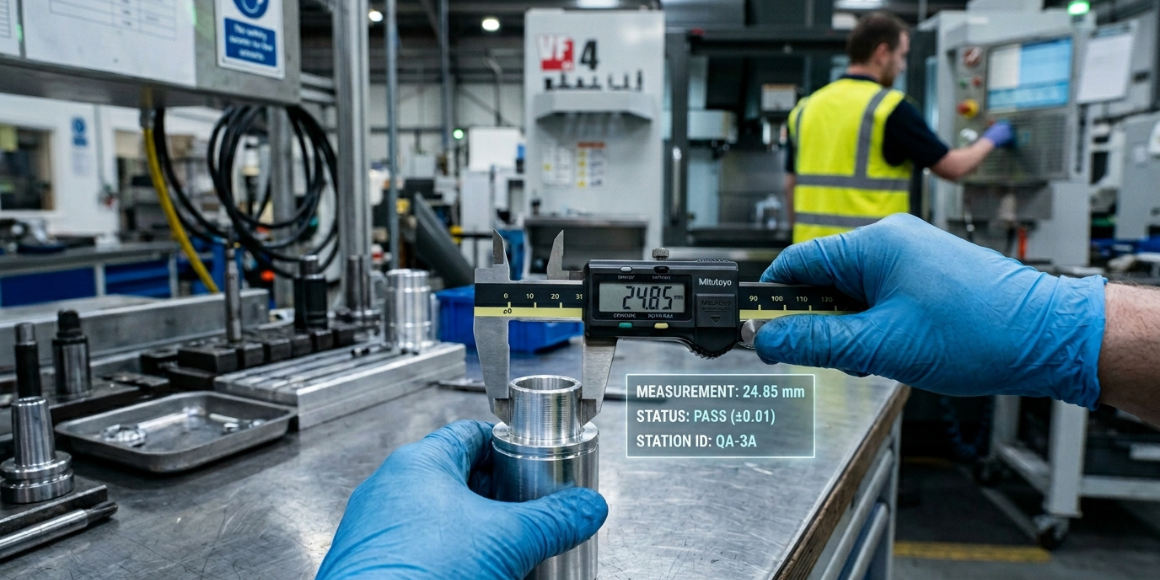
Measurement Consistency in Your Production Line
Measurement consistency lies at the core of any reliable production line. When measurements vary even slightly, the effects can ripple through operations, resulting in defects, material waste, and production delays. In industries with strict quality or safety standards, these inconsistencies may also lead to compliance issues or product recalls, both of which can damage a brand’s reputation.
The most fundamental way businesses address this is by using precision measuring tools. For example, optical comparators allow operators to inspect and verify part dimensions through magnified profiles, while surface and contour testers assess texture and form to ensure components meet required specifications. Because these tools play such a critical role, companies that depend on them even invest in regular calibration services to keep readings accurate over time.
Still, while precision tools form the foundation, they are only the first step. To keep measurements consistent across your entire production process, here are some additional strategies that can help reinforce accuracy at every stage.
1. Implement Standardized Measurement Practices
Using precision instruments is essential, but having the tools alone isn’t enough; how measurements are taken also plays a critical role in consistency. Standardizing measurement procedures ensures that every operator follows the same method, minimizing variability caused by differing techniques. This includes defining how parts are positioned, how measurements are taken, and how results are recorded. Clear guidelines make it easier to detect deviations and maintain consistent quality across batches.
By creating detailed standard operating procedures, companies can reduce errors and improve overall reliability. Consistency in measurement practices also makes it easier to train new employees and maintain quality standards as production scales or processes evolve.
2. Control Environmental Conditions
Environmental factors such as temperature, humidity, dust, and vibration can significantly affect measurement accuracy. For sensitive measuring instruments, such as micrometers or coordinate measuring machine probes, even small changes in humidity can lead to corrosion or affect lubrication, which in turn impacts the reliability of readings. Controlling these variables in production and inspection areas is therefore essential to reduce the risk of inconsistent measurements.
A stable environment not only supports measurement consistency but also helps extend equipment lifespan. Climate-controlled rooms, anti-vibration setups, and clean inspection areas are examples of measures that protect the accuracy of critical measurements.
3. Train and Certify Operators in Accurate Measurement Techniques
Even with standardized procedures, human error can introduce inconsistencies. Regular training ensures operators understand proper measurement techniques, can interpret readings correctly, and know how to identify anomalies. Certification programs further reinforce accountability and skill levels.
Properly trained operators are better equipped to maintain measurement consistency and contribute to overall quality control. They can detect deviations early and foster a culture of precision throughout the production line. Over time, this training helps reduce errors while improving efficiency, maintaining consistent quality standards throughout production.
4. Maintain Equipment through Preventive Maintenance
Even the most precise instruments and machines can drift or degrade over time, which can affect measurement accuracy. Regular preventive care, including cleaning, lubrication, parts replacement, and functional checks, helps ensure that production equipment and measuring instruments continue to operate reliably. If necessary, repairs should also be performed promptly to address any issues and maintain optimal performance.
By keeping machines and measurement devices in good working condition, companies can reduce unexpected errors, downtime, and variability in readings. This proactive approach reinforces consistent production quality and works hand in hand with operator training and standardized procedures.
5. Automate Data Collection and Measurement Checks
Manual measurement and record-keeping can sometimes cause errors and irregularities. Automation ensures that measurements are repeatable, precise, and recorded digitally, providing an accurate log for analysis and traceability.
Automated systems can also increase efficiency in high-speed production environments. For example, laser sensors can verify the dimensions of bottles or parts on the production line in real time, feeding data directly into quality management systems without human intervention.
6. Conduct Independent Audits and Cross-Checks
Independent verification adds an extra layer of reliability to the measurement process. Cross-checking results or conducting periodic audits helps identify deviations that routine inspections might miss. Companies can also hire specialized on-site or lab calibration services to validate that measuring instruments remain accurate.
These audits reinforce accountability and provide confidence in measurement data. They are especially useful in industries where regulatory compliance or tight tolerances are critical, as even minor discrepancies can have significant consequences.
7. Implement Feedback Loops for Continuous Improvement
Even well-established production processes can benefit from ongoing evaluation and improvement. Continuous monitoring of measurement data and process outcomes allows teams to learn from deviations and fine-tune operations accordingly.
With feedback loops, workflows, operator practices, or machine settings can be updated to minimize recurring deviations. An automotive manufacturer, for instance, might track dimensional variations in body panels over multiple production runs and use the insights to refine machinery and operator practices. This data-driven approach supports reliable production and consistent quality in every shift.
Driving Precision and Efficiency in Your Production Line
While the adoption of precision measuring instruments forms the foundation of accurate production, it can be further strengthened by complementary strategies. The approaches outlined above can guide you in improving your production line’s measurement reliability. With the right tools paired with effective processes, your business can minimize errors and instill consistent precision practices across the line.



Schedule an initial talk and get to know us better! You already have a basic brief? Send it over so we can have a more productive first meeting!
a meeting
