
EasyLine
INDUSTRY: INDUSTRIAL
COUNTRY: POLAND
CLIENT: Prevex Sp. z o.o.
SCOPE OF WORK:
- pre design
- conceptual design
- targeted conceptual design
- mechanical design
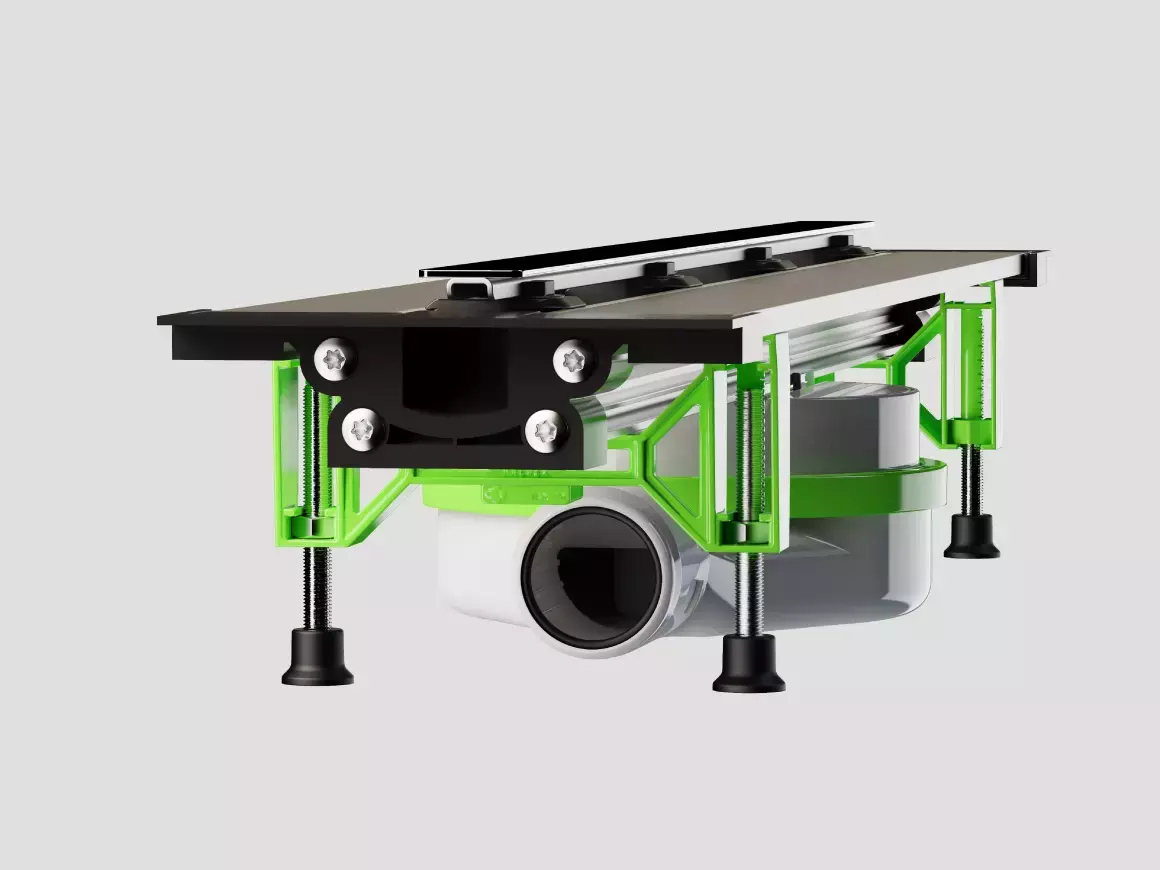
EasyLine has a proprietary adjustability solution as well as an excellent flow rate, among many other impressive characteristics. The product can not only be cut to any size between 350 and 1070 mm, but the grate can also be modified in height (and appearance). This allows you to choose EasyLine regardless of the thickness of the floor material or the evenness of the work surface. The rotatable water trap allows the device to be placed anywhere on the bathroom floor.

A client, a Polish bathroom siphon manufacturer, approached our company as he was preparing for a takeover by the Swedish company Prevex. Our client's company had a strong market position and had been specializing in the production of drainage systems and complementary products for years.
However, our client felt the need to refresh one of their products, a linear shower drain. Since the client's company did not have the necessary engineering capabilities, they turned to us for help.
The client's linear drainage system consisted of two systems: an external and an internal one. The external system, also known as the external grill, was located on the flooring surface, while the internal system, hidden in the floor, included a channel with seals and a mechanism for adjusting the external grill.
The client presented us with the following challenges. They wanted not only to refresh the appearance of the drain trough but also to improve some of its functions and greatly facilitate the installation process. They expected the new design to allow for:
- adjustment on the legs of the entire system,
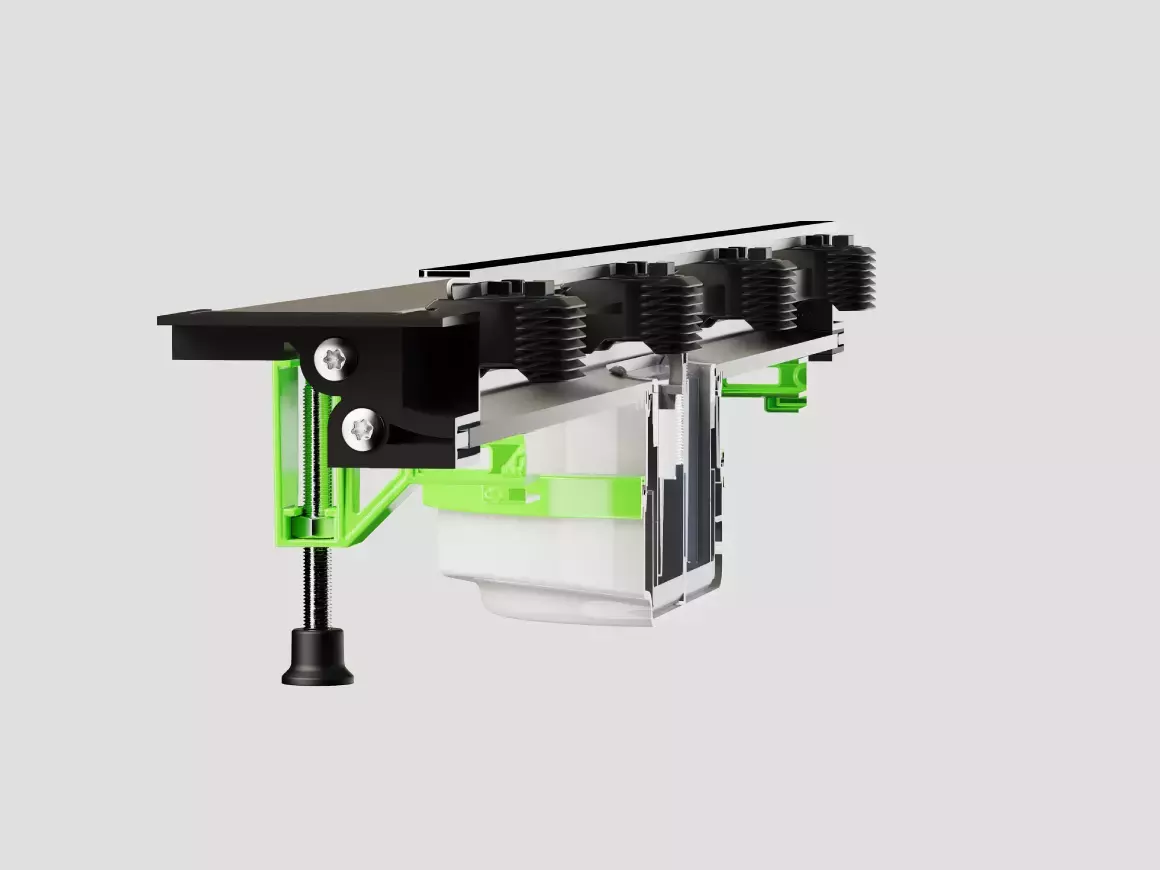
- smooth adjustment of the grill at two independent ends so that the external grill strip would adapt to the tiled slope of the shower base,
- adjustment of the profile length through modular extension or shortening, tailored to special needs, such as in spas,
- angular connection of the channel with seals, which would allow for the creation of custom drainage systems, e.g., in the shape of an "L" or a square,
- easy installation, comfort of cleaning and use, and high durability, e.g., to withstand standing on this element by people of various weights.
The project was particularly demanding at the initial stage of our work, requiring thorough research and testing of proposed solutions.

After preliminary research, it turned out that there were many patented solutions in the area of linear drains, especially concerning how the smooth adjustment of the grill itself is solved and how the height of the drain trough is adjusted. We suggested to the client to analyze the patent environment, and, wanting to ensure that by creating a new product, we would not infringe on any exclusive intellectual property rights, we commissioned a so-called patent clearance study. After the analysis, the project's goal became to design an alternative to existing and patented solutions that would allow achieving the intended functionality. The goal was achieved, and the project authors, Mikołaj Wiewióra and Rafał Piłat, received a patent (number EP19211634) awarded by the Patent Office.
An additional challenge of this project was designing a system that would allow for perfect drain trough closure while maintaining complete watertightness. We had to consider what mechanisms would be designed and propose a solution for adjusting the position of the grill grate (the only visible element of the drainage system). We had to ensure not only proper functional improvement but also solve the problem of this element's durability.
The project was quite unusual and required a specific approach: from the very beginning, all designed elements had to be structurally correct, considering the intended method of their production.
After analyzing various possible production technologies, we concluded that the best solution would be to use extrusion technology. We knew that regardless of the shape of the trough profile we decided on, it would be feasible to produce it using this technology. In further considerations, we sought the material from which the trough could be made, considering aluminum and synthetic materials.

design
The first proof of concept was to check whether the idea we came up with to solve the problem of grill height adjustment would actually work in practice. Without this, we could not model the other elements and move on to the next design stage. We created simple printed prototypes to verify the functionality. After successful verification, we proceeded to design the remaining parts of the system to conduct the first watertightness tests. We created a complete, structurally correct 3D model incorporating the design of seals and caps. After making prototypes, we conducted more tests, which ended successfully. The trough proved to be fully watertight.

conceptual
design
After delivering the prototype to the client, we received feedback noting that the proposed method of adjusting the grill height was not precise enough. The proposed method was based on a stepped solution, and the differences between the various levels were too large. We then decided to modify the original design of the adjustment element by adding a thread-based mechanism. We intended it to allow smooth adjustment to within 1 millimeter. We created another prototype, which confirmed our assumptions and verified the operation of this two-element solution. Furthermore, our solution allowed for perfect grill adjustment along the entire length of the profile, taking into account any unevenness in the floor. The client was delighted with the proposed system. At this stage, we could focus on the last problem, i.e., the method of adjusting the legs in the fully assembled drain.
When designing the legs for the trough, a seemingly minor part of the entire system, we saw the potential to significantly ease installers' work handling the drainage system installation.
Traditionally, the installer adjusts the height of the drain trough by screwing in or out of one of the four supporting adjustment screws. The installer usually uses a caliper to precisely adjust the height of the legs in pairs, recording the individual values for each side of the trough. We came to the conclusion that we could add a simple millimeter scale to the leg walls, which would indicate the level at which they had screwed in the leg screw. As a result, the need to remember values became unnecessary. Additionally, we came up with the idea of adding the possibility of temporarily connecting both legs together, creating a "miter box" that would allow us to easily shorten the main profile of the drain using an ordinary saw.
Except for the main drain profile, all other elements of the system were prepared for production using injection molding of synthetic material. We designed the entire system with proper geometry and manufacturing simplicity in mind.

design
In fact, mechanical design took place at every earlier stage. In order to verify design assumptions, we had to design all elements from the outset in their final form, taking into account the planned functionality and the intended production technology. The prototype met all of the brief's requirements and was fully operational. Thanks to this, we knew that our solution was effective, and we could proceed with preparations for the next stage, which was preparation for production.

for
manufacturing
We took care of the entire DFM (design for manufacturing) process. We prepared comprehensive recommendations regarding material choices, production technology, and assembly instructions. Furthermore, we developed CAD models incorporating manufacturers' recommendations and flat technical drawings. For production needs, we also compiled a complete Bill of Materials (BOM).

EasyLine has a proprietary adjustability solution as well as an excellent flow rate, among many other impressive characteristics. The product can not only be cut to any size between 350 and 1070 mm, but the grate can also be modified in height (and appearance). This allows you to choose EasyLine regardless of the thickness of the floor material or the evenness of the work surface. The rotatable water trap allows the device to be placed anywhere on the bathroom floor.
Every product design is the result of a team effort. It never boils down to one person, but every project has its lead designer or lead contributors. If you want to know more about our current team, visit our team page.


Schedule an initial talk and get to know us better! You already have a basic brief? Send it over so we can have a more productive first meeting!
a meeting
