
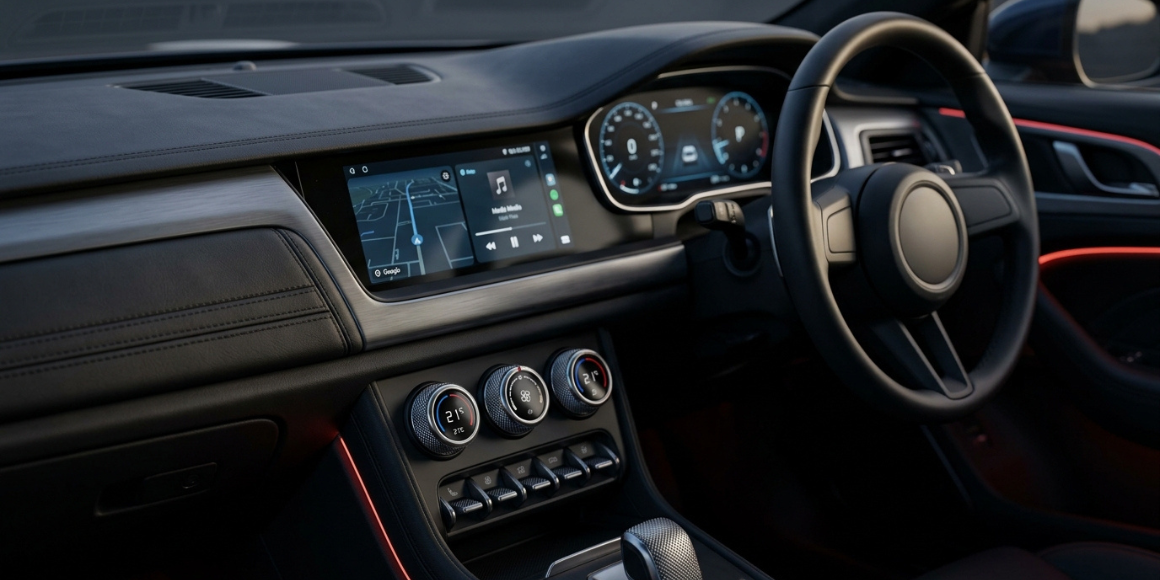
Volkswagen's CEO said the quiet part out loud. Reflecting on the brand's years-long bet on touch-sensitive controls, Thomas Schäfer admitted the strategy "definitely did a lot of damage" to Volkswagen's reputation. That's not a design blogger's hot take - it's the CEO of one of the world's largest automakers publicly admitting that ditching knobs and switches for glass backfired.
He's not the only one rethinking it. After a decade of touchscreens swallowing everything from car dashboards to kitchen counters, 2026 has become the year the pendulum swings back. An influential independent safety-testing body is now scoring physical controls directly into its ratings - the closest thing the auto industry has to hard regulation. Satisfaction data shows a clear, measurable link between simpler controls and happier customers. And across cars, kitchen appliances, and even vacuum cleaners, manufacturers are quietly reintroducing the dial, the knob, and the switch. Call it the return of physical buttons - and don't mistake it for nostalgia. It's a correction.
This article breaks down why the shift happened, who's leading the reversal, who's betting against it, and what it means for anyone designing the next generation of products.
Why Did Cars Remove Buttons in the First Place?
The shift toward touch-first interfaces wasn't accidental - manufacturers made a deliberate manufacturing and branding bet. Tesla's minimalist dashboard triggered the industry-wide shift: one central screen replaced dozens of physical switches, and "fewer buttons" quickly became shorthand for "more advanced."
The appeal made sense from a design-for-manufacturing standpoint. A single touchscreen costs less to standardize across trim levels than tooling, wiring, and stocking separate physical switch panels for every configuration. In 2026, Ferrari CEO Benedetto Vigna put an exact figure on that gap, telling Autocar India that touch controls cost roughly 50% less to produce than physical ones - confirming, straight from a manufacturer's mouth, what the industry had long implied but rarely admitted. Engineers can update a display with software instead of retooling hardware, and a glossy screen simply photographs better in marketing than a row of rocker switches - reinforcing the "premium tech" image automakers and appliance makers were chasing.
The catch is that this cost calculation only counted one side of the ledger. It tallied the savings in tooling and parts but skipped what happened once real owners started using these interfaces every day - in the dark, in the rain, wearing gloves, or adjusting the heat with wet hands. That's exactly the gap the data below exposes.
What JD Power's Satisfaction Data Reveals About Touchscreen Fatigue
If you want proof this isn't just internet grumbling, the numbers back it up. JD Power's Automotive Performance, Execution and Layout (APEAL) study recorded two consecutive years of declining new-vehicle owner satisfaction - the first time that's happened in the study's 28-year history - and infotainment drove the decline. By 2023, only 56% of owners said they preferred their car's built-in system for audio controls, down sharply from 70% just three years earlier.
JD Power's own release put it plainly: "for the first time in the 28-year history of the J.D. Power U.S. Automotive Performance, Execution and Layout (APEAL) Study, there is a consecutive year-over-year decline in owner satisfaction".
The trend didn't reverse on its own. JD Power's 2025 U.S. Multimedia Quality and Satisfaction Study found touchscreen and digital-display problems actually climbed year-over-year, from 4.0 to 4.2 problems per 100 vehicles. Infotainment stayed the single most problematic category in the accompanying Initial Quality Study, with automakers cited for burying basic functions - even the glove-box release or garage-door opener - inside touch menus.
Here's the pivot that turns this into a genuine trend story rather than a complaint roundup: the 2026 Initial Quality Study recorded the sharpest year-over-year quality improvement since 1997, and JD Power's benchmarking team credited simpler controls and software that "works the way customers expect". Interestingly, infotainment was the one category, out of ten, where problems actually rose in 2026 - driven mainly by Android Auto and CarPlay connectivity complaints. That doesn't undercut this article's core argument, though: among drivers who reported a distraction-related problem, 46% pointed to the touchscreen or infotainment system as the source - the most current, direct evidence that touch-related distraction hasn't gone away, even as the rest of the car gets better.
Euro NCAP's 2026 Scoring Now Penalizes Touchscreen-Only Controls
Consumer preference is one thing; industry scoring pressure is another. That's why 2026 specifically marks a turning point, rather than just another year of grumbling reviews.
Starting with its 2026 testing protocol, Euro NCAP - the independent European crash-test consortium, not a government regulator - began rewriting how it calculates star ratings across four newly defined "Stages of Safety": safe driving, crash avoidance, crash protection, and post-crash. A car doesn't automatically fail for burying essential functions inside a touchscreen menu, but it loses points toward its "Driver Engagement" score - worth 5 of 30 points within the Safe Driving area, under Technical Bulletin SD 203 - if it doesn't offer separate, physical controls for turn signals, hazard lights, the horn, front and rear wipers, high-beam control, the gear selector, eCall/SOS, and speed-control functions.
A note on the exact list: some early coverage cited a shorter five- or six-function set (horn, indicators, hazard lights, wipers, eCall). Euro NCAP's underlying technical bulletin lists nine functions, including the gear selector, high-beam control, and speed-control functions - the version reflected above.
Cars assessed in 2026 need a score of at least 60% to earn a five-star rating in each of the four test areas, not just Safe Driving - a threshold rising to 70% in 2027 and 80% in 2028. Physical-control scoring is just one line item stacked inside one of four scored areas, so a five-star rating is still technically achievable without full physical controls this year - but it's no longer a free pass.
Among the first cars tested under the new protocol, the Zeekr 7GT - despite earning five stars overall - was singled out for exactly this. Euro NCAP's own published rating notes that the car's "many key driving controls, as well as infotainment and comfort functions, rely on the centre screen." It adds that "Euro NCAP scores physical controls more highly for these sorts of functions". What Car?'s coverage of the same test summarized the practical effect as making those functions "more distracting to use on the move" - a live, current example of the exact penalty this article describes, even though that specific phrase is the outlet's characterization rather than Euro NCAP's own verdict language.
The rationale behind it is explicit: Euro NCAP is targeting eyes-off-road time. Every second a driver spends navigating a touch menu to find the hazard lights is a second they're not watching the road. This isn't a hunch - real-world road tests back it up. In 2022, Swedish car magazine Vi Bilägare timed how long it took drivers to complete four simple tasks (like turning on the seat heater or adjusting the temperature) while driving. In a 17-year-old Volvo V70 with purely physical buttons, it took 10 seconds. In a BMW iX, controlled almost entirely through touch, the same tasks took 30.4 seconds. A 20-second gap sounds abstract until you calculate how far a car travels at highway speed while the driver's attention is split between the road and the screen.
An influential safety-testing body writing points-based scoring into its protocol, and a real car already penalized for it in its first year, gives this part of the button story real staying power in design and safety press. It's not opinion - it's testable, measurable, and now has a named example on the record.
VW, Hyundai, Renault, and Porsche vs. BMW: Inside the Industry Split
Not every automaker is responding the same way, and that disagreement is arguably the most interesting part of this story. Some brands are reversing course fast; others are doubling down on touch and voice.
.png)
This is an unresolved bet, not a unanimous verdict. Volkswagen and Hyundai are reacting directly to complaints and the Euro NCAP scoring shift. Porsche's reversal shows the trend isn't confined to mass-market brands responding to regulation - it's also happening at the premium end, where tactile "feel" is part of the product itself. Renault never bought into the touch-only trend in the first place, treating it as a cost worth paying - and its philosophy lines up directly with Euro NCAP's own stated rationale: the agency's updated protocol calls for "the availability of physical buttons for commonly used functions, which consumer feedback suggests can reduce distraction", the same logic Sealey and Vidal have described independently for years.
BMW, meanwhile, is wagering - through one executive's public comments rather than a formal company position - that generational preference will eventually vindicate a screen-and-voice-first cabin. That bet faces headwinds beyond Europe, too: new Chinese regulations taking effect in 2027 will require physical controls for over a dozen functions, including indicators, headlights, wipers, and transmission controls. Whoever proves right will shape interior design for the next decade of vehicle platforms.
The Button Comeback Beyond the Dashboard: Kitchens, Vacuums, and More
Cars carry the loudest part of this story, but they're not the only one - the same touch-versus-tactile argument plays out on kitchen counters and in cleaning cupboards.
Physical knobs on cooktops let you adjust burner heat by feel, even with wet, greasy, or gloved hands - something a flat capacitive panel can't replicate reliably. Touch panels on dishwashers and ovens are proving fragile in practice, too: steam, condensation, and detergent residue degrade capacitive sensors over time in a way a sealed mechanical knob simply doesn't experience. And when a touch panel fails, repairs cost noticeably more than swapping a physical knob or switch.
Here's a quick scorecard on which products get the tactile-versus-touch balance right - and which don't:
Getting it right:
- Cooktops and ranges that pair a digital timer display with physical knobs for heat control, combining precision with the reliability of a mechanical dial.
- Stick vacuums and similar cleaning tools that use a simple physical trigger or switch for power, prioritizing reliability over a "smart" touch strip prone to failure under heavy daily use.
- Hybrid "knob-on-display" hardware, where a physical dial sits directly on top of a digital screen, delivering tactile feedback and visual flexibility at once.
Getting it wrong:
- Fully flat touch-control ranges and induction cooktops that require multiple taps to adjust a single burner, raising the risk of a missed input mid-cook.
- Washing machines and dryers that hide basic cycle selection behind a single touchscreen with no physical fallback if the display glitches or gets wet.
This shift isn't happening in a vacuum. Architectural Digest documented the same pattern in luxury home technology, quoting residential architect Andrew Franz, who says his clients "are weary of digital life and prefer simplicity and physical controls" as a reason smart-home projects are dialing back app-based control in favor of visible switches.
The pattern shows up in raw search data, too: Google searches for "analog hobbies" climbed more than 1,300% over the past year, and Michaels reported a 136% spike in searches for analog crafts specifically - a shift significant enough that the Global Wellness Summit coined the term "analog-ing on" to describe tactile, pre-digital activities as a wellness practice rather than pure nostalgia. That cultural backdrop isn't the main driver of the button comeback, but it acts as a tailwind behind it, priming consumers to notice and appreciate tactile controls when manufacturers bring them back.
The Hidden Cost of Touchscreen-First Design
Here's the real lesson for anyone building physical products, not just cars: touchscreens looked cheaper, but they weren't. The cost simply moved downstream.
On a pure bill-of-materials basis, a single glass display beats tooling multiple physical switch panels across trim levels. But that calculation ignored three real costs that surfaced later. Falling satisfaction scores damaged brand reputation and resale value. Warranty and goodwill costs piled up from a decision Volkswagen's own CEO now calls damaging. And, starting in 2026, a new cost entered the equation: lost points in an influential safety scoring system that consumers and reviewers increasingly reference when comparing cars - as the Zeekr 7GT already discovered in its very first assessment.
This is a design-for-manufacturing lesson as much as a UX one. When designers swap a physical control for a touchscreen without accounting for glance time, tactile feedback, and failure-mode reliability, they don't eliminate cost - they transfer it to the customer-service line, the warranty budget, and now the safety-scoring column. Companies now scrambling to add physical controls back into finished platforms are effectively paying a second tooling bill for a decision they could have avoided the first time.
Don't expect a full swing back to pure analog dashboards, though. The more likely path for 2027 and beyond is a hybrid compromise: physical knobs and switches handle the functions that need to be operated by feel or under time pressure - volume, climate, hazards, indicators - while touchscreens take over secondary functions where glance time and split-second feedback matter far less, like navigation details or ambient lighting settings.
The Bottom Line on the Button Comeback
Touchscreens were never wrong because they're digital. They were wrong because an entire generation of designers treated buttons as a legacy feature rather than what they actually are: a safety and usability requirement that also happens to feel good under your fingers. The brands correcting course now aren't going backward - they're relearning something ergonomics research already knew before the first capacitive screen ever shipped.
If a decade of touchscreens-on-everything taught the industry one thing, it's this: convenience for the manufacturer and convenience for the user aren't automatically the same thing. Sometimes the smartest interface is the one you never have to look at - which is exactly why your next kettle might have a real switch again.



Schedule an initial talk and get to know us better! You already have a basic brief? Send it over so we can have a more productive first meeting!
a meeting
