
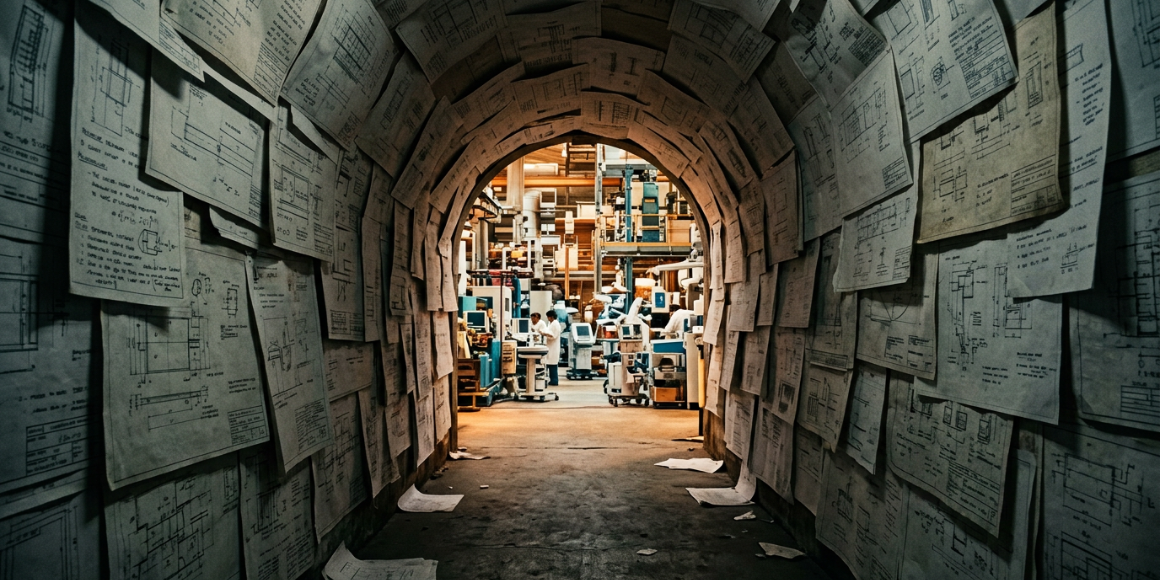
This is one of those conclusions that sounds counterintuitive until you look more closely: your most stable team can become your biggest limitation. Not because it lacks competence, but because over time it becomes increasingly skilled at navigating the same solution space. Research on design teams shows that the performance of groups working together for years with a stable composition first rises and then begins to decline. The longer a team operates in the same domain, the more easily it locks into its own patterns, the less it looks outward for new knowledge, and the more cautiously it treats ideas that didn't originate from within its own way of working.
For product design, the takeaway is highly practical. When evaluating a design partner - or trying to understand why your internal team keeps arriving at similar answers - it is worth asking not who knows your industry best, but who can see your problem from outside it. The team most likely to find a truly fitting solution is often not the one that knows a single sector most deeply. More often, it is the one that has learned to work at the intersection of several different worlds.
Expert Knowledge Is Also a Filter
The mechanism is simple. Expertise is built through pattern recognition: you quickly learn to distinguish between what matters and what seems like noise. That is a huge advantage. The problem begins when the categories of "important" and "unimportant" are defined solely by experience from one industry. What seems obvious or not worth attending to from that perspective may, in another field, be precisely the missing piece of the solution.
This is exactly why cross-industry experience is not merely an attractive addition to design capabilities. Research on technology brokering shows that designers working across multiple industries develop new solutions not because they know more about one sector, but because they have access to a broader library of patterns, materials, mechanisms, and mental models. Their advantage does not lie in having a "fresh perspective" in a general sense. It lies in recognizing that a problem considered specific in one industry may have been solved long ago somewhere else.
How Cross-Industry Transfer Works
Innovation at the intersection of industries does not come from magic or creativity alone. It is driven by analogical thinking - the ability to spot structural similarities between the current problem and a solution that already exists in another field. The most valuable innovations very often are not about creating knowledge from scratch. They emerge when someone can move existing knowledge across the boundary between industries that had not previously talked to one another.
For that to be possible, the problem first has to be properly defined. Framing it as "how to improve ski performance at high speed" leads to an entirely different search than "how to reduce vibration in a moving structure," even though both may concern the same technical difficulty. The level of abstraction determines where you will look for answers. The better you can lift the problem out of the language of your own product category and describe it in terms of function, phenomenon, or behavior, the greater the chance of finding a useful analogy.
Not every outside perspective is equally valuable, however. If you search only in adjacent industries, you will usually find incremental solutions - exactly the kind your competitors are probably already exploring. If you reach too far, you may end up with inspiration that cannot be translated into technical, regulatory, or manufacturing requirements. The most productive space lies between those extremes. It is a zone of adjacent unfamiliarity - where the solution comes from another world, yet can still be meaningfully adapted.
Component Transfer and Model Transfer
In practice, it is worth distinguishing between two kinds of cross-industry transfer. The first is component transfer: when a material, sealing standard, fastening method, or manufacturing process moves from one field to another. This kind of transfer can be very useful because it can often be implemented quickly and deliver an immediate, tangible design benefit.
The second type is model transfer. In that case, you are not transferring a single element of a solution, but a way of understanding the entire problem: an assumption about how the system works, how the user behaves, or where the real source of the difficulty lies. This kind of transfer is rarer and harder to pin down, but very often it is what leads to a breakthrough. The point is not to borrow a ready-made detail. The point is to change the question that sets the entire design process in motion.
Three Transfers That Changed Entire Industries
Some of the best-known product innovations of recent decades are precisely this kind of transfer. James Dyson did not invent new physics; he looked at the industrial cyclone separator and asked whether the same principle could replace the bag in a vacuum cleaner. Eiji Nakatsu, working on the pressure wave generated by the Shinkansen as it exited a tunnel, did not stop at the language of "train aerodynamics" but defined the challenge more broadly - as a transition between two media of different density - and found an analogy in the shape of the kingfisher's beak. The Wright brothers, in turn, did not borrow only components from the bicycle industry. What mattered most was that they transferred a mental model: the understanding that a vehicle in motion is dynamically unstable and requires active control of balance.
.png)
Each of these examples shows the same underlying pattern. Real transfer does not work on a copy-and-paste basis. It requires translating a solution into a new context, testing it, and refining it. Dyson built thousands of prototypes. Nakatsu had to go through the rigor of aerodynamic testing. In both cases, the advantage did not lie simply in finding inspiration, but in defining the starting point more accurately than the competition.
What It Looks Like in Practice
This is exactly the kind of thinking that shapes our approach to new projects. Our portfolio includes medical devices, industrial robotics, aviation, smart city infrastructure, consumer electronics, and fintech solutions - not because we want to collect industries, but because each of them brings different mechanisms, different constraints, and different ways of defining problems into the next project. When we begin work in a category we have previously encountered from a different angle, we are not starting from scratch. We carry knowledge that can be adapted.
A good example was a linear drain project in which we had to design an adjustment mechanism for the visible grate - the element the user not only sees, but actually walks on. The challenge was to ensure that the grate could be securely seated, locked in place, and leveled with great precision relative to the surrounding tiles, even though the slopes on either side of the drain could differ. At the same time, we were working in a category where many solutions based on screws, spacers, and similar adjustment mechanisms already existed - often within a dense patent landscape. The task was therefore not to design yet another variation on the same theme, but to find a different operating logic.
The turning point came when we drew on experience from projects based on extruded profiles. Instead of treating the task as just another problem from the plumbing fixtures category, we brought it down to a more fundamental question: how do you build a stable, multi-level support system that enables predictable adjustment, transfers loads effectively, and does not require copying the typical solutions used in this category? That shift in perspective allowed us to design the drain channel profile so that its geometry itself created ledges for a wedging element. We paired it with a rotating locking block that, once turned, seated itself in the profile notches and created a stable mounting point for the grate.
The first version of the solution delivered very good load strength and stepped adjustment, which testing confirmed. It quickly became clear, however, that stability alone would not be enough in this case. We also needed adjustment precision of around 1 mm - necessary to bring the grate surface perfectly flush with the tile surface. That is why we extended the system with an additional threaded element screwed into the adjustment block, which allowed us to move from stepped adjustment to precise height tuning. This was not a simple transfer of a ready-made detail from one industry to another. It was an adaptation of a design principle: using the profile geometry as an active part of the adjustment mechanism. And that is precisely the kind of transfer that most often proves most valuable.
.png)
What the Data Says
The data supports this way of thinking, although its significance is easy to oversimplify. The point is not that external sources of innovation always replace in-house R&D. The point is that organizations achieve better results when they can systematically combine internal development with knowledge, solutions, and capabilities acquired from outside. A classic example remains the Connect + Develop program created by P&G, which led to higher R&D productivity, better implementation success rates, and - simultaneously - a lower R&D cost-to-sales ratio.
In practice, the greatest benefit does not come from "borrowing other people's ideas," but from reducing costly aimless searching at the direction-setting stage. If a solution has already worked elsewhere, you can assess more quickly whether its logic makes sense here as well. That is exactly why open innovation remains one of the most important topics in innovation strategy, and why time-to-market pressure further amplifies the value of approaches that shorten the phase of blind exploration.
An Honest Counterargument
It would not be honest to claim that an external team always performs better. That thesis does not hold up to critical scrutiny. In-house teams have advantages that cannot easily be replicated: institutional memory, familiarity with the history of design decisions, experience with specific suppliers, processes, regulatory pathways, and organizational constraints. When rapidly iterating on an existing product platform, a team that knows the tooling, supply chain, and earlier engineering trade-offs will often be faster and more effective than any external partner.
The most fitting approach, therefore, is not rivalry but complementarity. Internal teams are responsible for continuity, compliance, and the long-term coherence of the product. External partners contribute the most when the task is genuinely new: when a company is entering an unfamiliar category, deploying a novel technology, or trying to reach a user it has not served before. It is precisely in those moments that cross-industry experience stops being a curiosity and becomes an operational advantage.
Mikołaj Wiewióra (Senior Designer) from Mindsailors puts it this way: "most often, what I bring to a new project is not a ready-made solution, but a different logic for approaching the problem. The client usually expects us to stay within the materials and technologies typical of their category. And yet the most valuable moment often comes when something from an apparently distant project suddenly turns out to be structurally very close. That was the case with the AED cabinet, where for a long time we considered classic structural solutions and additional insulation layers. The breakthrough came only when we returned to our experience from a recuperator project, in which an EPP component served both a structural and an insulating function simultaneously. It turned out that we could use the insulating material - EPP - as the load-bearing structure for the electronics, the internal components, and the means of mounting the AED itself, replacing the outer sheet metal casing and several internal parts that we consolidated into a single main component together with the rest of the product. This is exactly the kind of transfer that most often proves most valuable - not when you copy a detail, but when you recognize the same underlying principle at work in a completely different context."
How to Do It Deliberately
Both literature and practice agree that effective cross-industry transfer can be organized into a few steps. First, define the problem structurally, not in the language of a single industry. Next, seek analogies in fields with a similar operating logic. Then assess whether the transfer can withstand contact with material, manufacturing, regulatory, and user realities. Finally comes the most difficult stage: adaptation with engineering rigor - because simply recognizing the analogy is only the beginning of the work.
This approach has one more advantage that often goes unnoticed in discussions about sustainability. Reusing components, engineering principles, or processes originating in other fields not only reduces the waste of knowledge and materials. Research also shows that solutions drawing on non-obvious sources tend to be perceived as more creative and more appealing. In that sense, the circular economy and cross-industry knowledge transfer share a common core: both rely on recognizing value where others already see a closed context.
AI Speeds Things Up - But Doesn't Replace Experience
At this point, a natural question arises: if finding analogies across industries offers such an advantage, can't you simply hand it off to AI? To some extent, you can. Generative AI is now very useful in the early stages of exploration. It can quickly identify structural similarities between problems from different fields and significantly shorten the time needed for initial research.
Its limitation becomes apparent, however, when you need to assess whether a given analogy can actually hold up in a real project. AI is good at surface-level associations and broad mapping of possibilities, but it cannot independently verify whether a transfer will withstand production tolerances, material constraints, regulatory requirements, and real user behavior. AI speeds up the search. Experience validates the transfer. Without the latter, it is very easy to mistake inspiration for a solution.
Is This the Right Moment?
Cross-industry knowledge transfer makes the most sense in very specific situations. When a team has been developing the same platform for several years without any fundamental rethinking. When an organization is entering a category it has not worked in before. When market analysis shows that the roadmap is starting to look like a variation on what competitors are doing. Or when successive development cycles keep solving the same structural problem, only in a slightly different form.
If even one of these situations sounds familiar, the problem usually is not a lack of competence. Much more often, it is that deep specialization has narrowed the search space more than the organization is willing to admit. At such moments, what proves most valuable is not a new tool or another benchmark, but a different way of asking the question at the very start of the process.
The Question Worth Asking
Most companies look for the best answers their own industry has developed. Far less often does the question arise of who has already solved this problem in a field they have not yet considered. And that is very often precisely where real advantage begins.
Cross-industry knowledge transfer is not a matter of creative taste or a compelling narrative about a "fresh perspective." It is a concrete strategy for working with design problems. Teams that know how to apply it consciously - teams that understand how to choose the right distance, how to distinguish inspiration from a useful analogy, and how to carry out adaptation without losing rigor - increase the likelihood of solutions that are not only more original, but above all more fitting. The zone of adjacent unfamiliarity really does exist. The only question is whether, in your project, someone knows how to recognize it.




Schedule an initial talk and get to know us better! You already have a basic brief? Send it over so we can have a more productive first meeting!
a meeting
