
The prototype gets approved. The manufacturer confirms tooling is ready. The launch date locks in place. Then someone finally asks: "So what does the box look like?"
For most founders and product teams, packaging design starts right there - after everything else wraps up. The logic seems sound: the product comes first, and packaging just adds a finishing touch.
When you're selling online, that order works against you - and it's a costly mistake. E-commerce packaging isn't a graphics task you tack onto a finished product. It's an engineering and logistics problem that needs a seat at the table while the product is still taking shape.
Getting this wrong carries a real, measurable cost. Damage sustained in transit is a recurring driver of e-commerce returns, and replacing a damaged product often costs far more than the original shipping charge. This guide explains what e-commerce packaging actually needs to do, when packaging design should enter your product development timeline - ideally alongside Design for Manufacturing (DFM), the engineering process that locks in a product's geometry, materials, and assembly method - and what your team should decide before briefing a packaging designer.
E-Commerce vs. Retail Packaging
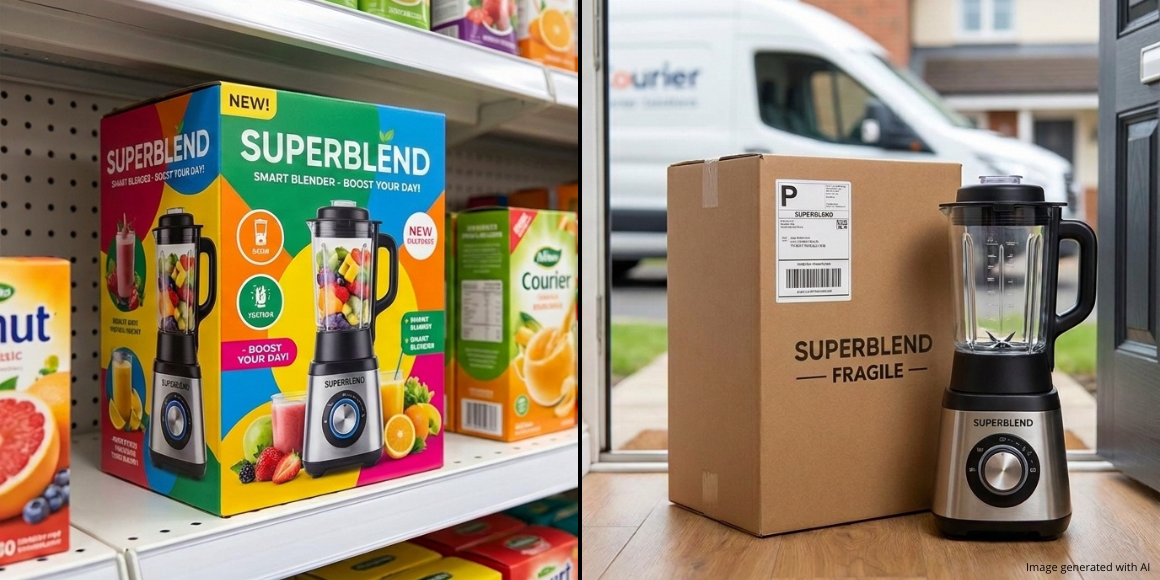
The sales channel changes everything about what packaging needs to do. On a retail shelf, packaging works like a salesperson, grabbing attention in the few seconds shoppers spend scanning competing products. Online, the purchase decision happens long before the box ever arrives.
That flips packaging's job completely: it has to protect the product through transit and deliver a brand experience the moment it lands on the customer's doorstep. This shift matters more than most teams realize.
- Handling gets far rougher. Industry logistics research puts the number of touchpoints an e-commerce parcel passes through - sorting facilities, delivery vans, drop points, and last-mile handoffs - well above what a retail product experiences before reaching a shelf. Each touchpoint adds another chance for damage.
- Damage hits the bottom line in two ways: the direct cost of replacement, and the reputational cost - customers who receive a damaged product are measurably less likely to buy from that brand again, a pattern documented across multiple carrier and retailer damage studies.
- Packaging now doubles as a brand moment. Multiple consumer packaging surveys have found that design and unboxing quality influence purchasing and repeat-purchase decisions, and many online shoppers post unboxing photos or videos on social media. The box has stopped being just protection - it's become a marketing asset that arrives after the sale rather than before it.
How Retail and E-Commerce Packaging Differ
.png)
These differences between retail and e-commerce packaging are widely reflected in transit testing guidance and case studies on e-commerce packaging.
If your product was originally designed with a retail shelf in mind - or if you're assuming standard packaging will "just work" for direct shipping - this is the first assumption worth challenging.
The Four Jobs E-Commerce Packaging Must Do
E-commerce packaging doesn't solve for a single objective. Good packaging has to meet four requirements at once, and optimizing for one often creates friction in another. Most packaging mistakes trace back to a team solving for one job while ignoring the rest.
1. Physical protection
This is the baseline requirement, and it demands more than most teams expect. Products shipped direct-to-consumer face shock, compression, vibration, and atmospheric stress that retail packaging was never built to withstand.
ISTA transit testing simulates these hazards and shows whether packaging can hold up. ISTA 3L is the generalized ship-in-own-container test used across most e-commerce retailers and marketplaces, while ISTA 6-Amazon.com-SIOC is Amazon's own retailer-specific version, required for products enrolled in Amazon's packaging certification program. For sellers on Amazon, shipping non-certified packaging on qualifying products can trigger financial chargebacks and added scrutiny under that program.
The complication: the right ISTA test tier depends on product weight, dimensions, and fragility rating - data that only exists once product design nears completion. You can't properly test packaging against a product that's still changing shape.
2. The unboxing experience
The unboxing moment gives customers their first physical brand touchpoint. It shapes perception, drives social sharing, and often influences repeat purchases - a link consistently found in unboxing and consumer packaging research. The goal isn't "more packaging" - it's intentional sequencing.
What does the customer see first when they open the box? What do they discover next? A tissue layer, an insert card, a deliberate reveal: these choices shape the emotional arc of opening the package, and they don't necessarily cost more than an unplanned default would.
3. Shipping efficiency and dimensional weight
Carriers charge by dimensional weight, not just actual weight. An oversized box holding a small, light product still gets billed as if it occupies all that volume. Oversized packaging drives unnecessary shipping costs across e-commerce.
Right-sizing packaging to match product dimensions isn't just a sustainability talking point - it's a direct line item on your shipping invoice. And it only works if you base packaging dimensions on actual, finalized product measurements, not early-stage estimates.
4. Sustainability and regulatory compliance
Sustainable packaging has moved from "nice to have" to compliance-critical, especially across European markets. The EU Packaging and Packaging Waste Regulation (PPWR) entered into force on 11 February 2025 and will generally apply from 12 August 2026, tightening requirements around recyclability, recycled content, chemical limits, and labeling for packaging sold in the EU.
.png)
European consumers increasingly expect sustainable packaging by default, and industry consumer research links non-sustainable packaging perceptions to reduced repeat-purchase intent. Industry trend trackers have named "substantiated sustainability" the leading packaging trend heading into 2026, meaning brands need to back sustainability claims with verifiable evidence rather than marketing language.
Digital product passports - QR or NFC links to lifecycle data - are also on the horizon, rolled out category by category under the EU's Ecodesign for Sustainable Products Regulation (ESPR). Batteries are the first mandatory case, with full passport obligations applying from 18 February 2027; packaging itself isn't yet a standalone mandatory category, but brands should expect packaging-linked data requirements to follow as more product categories come into scope over the next few years.
The Packaging-DFM Connection
One point most packaging guides skip entirely: engineering decisions set packaging constraints, not graphic design choices. Design for Manufacturing (DFM) determines product geometry, material selection, assembly sequence, fragility classification, and production volume - and each of these directly shapes what packaging is even possible.
Leave packaging out of that conversation, and you usually get one of two outcomes: expensive re-engineering to fit the packaging around the product, or packaging that quietly underperforms its brief.
In practice, this shows up in four ways:
- Product geometry dictates packaging structure. A product with protruding connectors, an irregular footprint, or an asymmetric form needs custom-formed inserts - foam, molded pulp, or vacuum-formed trays. That insert geometry can't be finalized until the product's geometry is locked.
- Material selection sets the fragility classification. Whether a product's casing uses ABS plastic, die-cast aluminium, or a composite affects its drop-test tolerance. That fragility rating then shapes which ISTA test tier applies and how much protective material the packaging actually needs.
- Assembly method drives insert logic. If a product ships as a kit rather than fully assembled, the insert has to hold multiple components in a sequence that matches the customer's assembly flow. That's a mechanical and UX decision, not a print decision.
- Production volume reshapes the entire packaging system. A first run of a few hundred units gets hand-packed. A run of several thousand units at a fulfillment center may need automated box-folding and insert placement. Packaging has to match how it will actually be filled and shipped.
Skipping packaging in this conversation raises the risk of it delaying the launch further down the line.
For example, take a product with a protruding sensor module and a charging assembly. That geometry simply won't fit into a standard shelf-box insert. A packaging designer needs finalized product geometry, cable routing, and charging dock dimensions to create an insert that actually works. Request that after tooling is already committed, and any change costs far more - while also delaying launch.
.png)
When Packaging Design Should Begin
Not at the very beginning, while product geometry still shifts - but definitely not at the end, either. The right entry point falls at, or just before, the DFM phase.
Too early: concept and ideation
Product form, dimensions, and materials all remain subject to change here. Detailed packaging work at this stage will likely get discarded. That said, packaging constraints should still be noted early: which channel will this product sell through - Amazon FBA, direct-to-consumer courier, retail, or a mix? That single decision shapes the packaging brief later on.
The right moment: approaching DFM
This is the sweet spot:
- Product geometry is locked or nearly locked
- Materials and surface finishes are selected or narrowed down
- The assembly sequence is defined
- A production volume estimate exists
- The fulfillment method (hand-pack, automated, Amazon FBA) is decided
At this point, a packaging brief can be built on actual product data instead of guesses - and that's what separates packaging that works from packaging that needs a redesign.
Too late: post-tooling
Once tooling is locked, any packaging change that requires a product geometry change now carries tooling cost. Inserts designed against incorrect dimensions need new tooling of their own. If ISTA testing later reveals insufficient protection, changes at this stage become extremely expensive, and launch delays become likely.
A design change at concept stage may cost hours; the same change after tooling can cost weeks and real money - and packaging follows that same cost curve, just one stage later.
Key Design Decisions for E-Commerce Packaging
Once your product nears DFM and you can write a real packaging brief, two parallel tracks demand attention: structural design and graphic or brand design. Most teams jump straight to the visual side, but structural decisions should come first because they determine what's physically possible.
Structural design decisions
- Box format and material grade. Choose between single-wall or multilayer corrugated, a mailer box, a rigid set-up box, or a poly mailer. Each option strikes a different strength-to-cost balance depending on product weight and fragility.
- Insert design. Foam, molded pulp, vacuum-formed plastic trays, or corrugated fillers should be driven by product geometry and fragility rating. Custom inserts also bring their own tooling and lead time.
- Right-sizing. Keep external dimensions as close as practical to the product's actual footprint to reduce dimensional weight charges.
- Resealability. For direct-to-consumer brands with meaningful return rates, packaging that can be resealed and reused for return shipment improves customer experience and reduces logistics costs. A simple tear-strip plus return seal can save support tickets and extra boxes.
- Fulfillment compatibility. Match the assembly method (self-locking flap vs. taped closure) and packing approach (hand-pack vs. machine-fill) to how your fulfillment partner actually operates.
Graphic and brand design decisions
- Print method and finish. Digital print suits low minimum order quantities, while offset litho becomes more cost-effective at volume. Finishes like foil, embossing, or soft-touch laminate carry their own cost and MOQ implications.
- Exterior vs. interior branding split. E-commerce packaging often inverts retail logic: the exterior stays plain and cost-efficient, while branding concentrates on the interior, where the real unboxing experience happens.
- Unboxing sequence. Decide deliberately what the customer sees first, second, and third, rather than leaving it to chance.
- Sustainability signaling. Verify recycling symbols, certification marks, and material callouts for accuracy, given tightening regulatory scrutiny under the PPWR.
.png)
The Most Common E-Commerce Packaging Mistakes to Avoid
Founders launching their first custom packaging order tend to repeat a small set of avoidable mistakes - most of them traceable to packaging entering the process too late rather than at the wrong stage.
- Treating packaging as an afterthought. When packaging design starts only after manufacturing decisions are locked, redesigns become far more likely.
- Using retail packaging for direct shipping. Shelf-optimized packaging wasn't built for the e-commerce supply chain, and standard courier networks expose that weakness quickly.
- Getting the box size wrong. As covered above, carriers bill by dimensional weight, not actual weight - so a box that doesn't match the product's real footprint quietly inflates shipping costs on every single order.
- Skipping physical samples. Decisions made only from renders raise the risk of bad insert fit, weak box integrity, poor print quality, and awkward opening sequences.
- Skipping the sustainability plan. For products entering European markets, PPWR-related requirements around labeling and material choices need to be built into the brief from the start.
- Over-ordering on the first run. Packaging quantities should follow the sales forecast, not just the manufacturer's minimum order quantity.
Questions to Answer Before You Brief a Packaging Designer
A packaging designer can only work as well as the brief they receive. Your product and engineering team should answer these questions with real data - not estimates - before the design conversation starts.
Engineering and product inputs
- What are the exact, finalized product dimensions and weight?
- What's the product's fragility rating, and has drop testing confirmed it?
- What materials make up the casing, and are any surfaces sensitive to scratching or pressure?
- Does the product ship fully assembled, or as a kit with separate components?
- Do accessories, cables, or documentation need to be included?
- Does the product react to moisture, static, or temperature changes in transit?
Channel and logistics inputs
- What's the primary sales channel - Amazon FBA, direct-to-consumer courier, B2B pallet, or a mix?
- Which carrier will be used, and how do they calculate dimensional weight?
- What quantity will be ordered for the first production run?
- Will fulfillment be manual, or handled by automated equipment at a fulfillment center?
- Does the product require ISTA transit testing, and if it will be sold on Amazon, which tier applies (for example, SIOC vs. overboxed)?
Brand and market inputs
- What's the intended retail price point?
- Which markets will the product sell into? EU markets carry PPWR-related requirements.
- What sustainability commitments need to show up in material choice and labeling?
- Is the goal a functional, minimal unboxing experience or a premium, shareable one?
Answering these questions before the brief goes out saves revision rounds later. That's the difference between a packaging designer guessing and a packaging designer solving a clearly defined problem.
Packaging Design Is a Product Development Decision
Starting packaging design after tooling is locked costs the most. Starting it when product geometry is near-final costs the least, and every stage in between costs more than the one before it. If your team is moving through DFM and hasn't opened the packaging conversation yet, raise it now - before geometry locks, not after. At Mindsailors, we can help teams think through packaging alongside the product itself, so it never becomes the afterthought that derails a launch.


Schedule an initial talk and get to know us better! You already have a basic brief? Send it over so we can have a more productive first meeting!
a meeting
