
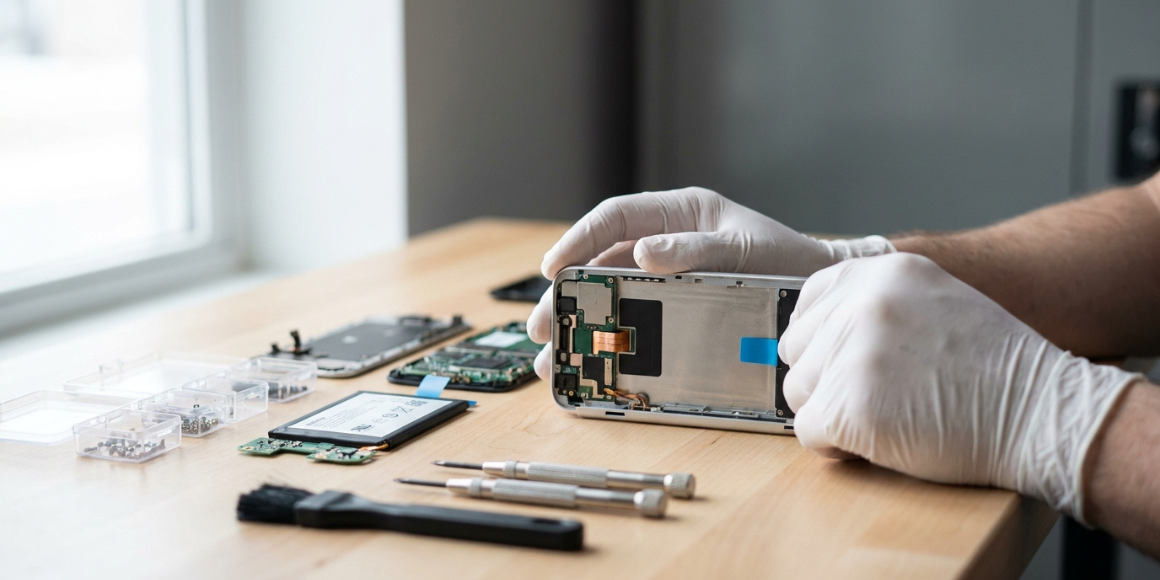
The EU's Right to Repair Directive (2024/1799) took effect on July 31, 2026 - just over two years after entering into force. For product designers, hardware manufacturers, and engineering teams, this wasn't a distant regulatory footnote. It's now active law, already reshaping how companies build, warranty, and service their products.
What This Guide Covers
This guide explains what the directive requires, why it matters even outside the EU, and what consumer data reveals about demand for repairable products. More importantly, it shows how design teams can turn repairability into a real product advantage instead of a last-minute compliance scramble. Whether you're launching a hardware startup's first product or managing compliance across an established manufacturing line, understanding this shift now will save costly redesigns later.
What Is Right to Repair, and Why Did It Happen Now?
Right to Repair is both a legal framework and a design philosophy. At its core, it gives consumers and independent repairers reasonable access to the parts, tools, and information they need to fix products, rather than pushing them toward premature replacement the moment something breaks.
The EU's Legislative Timeline
The EU's version of Right to Repair followed a clear legislative path. The European Parliament adopted the final directive text on April 23, 2024, with an overwhelming 584 votes in favor, just 3 against, and 14 abstentions - one of the most lopsided margins of the legislative term. The directive entered into force on July 30, 2024, giving member states 24 months to transpose it into national law, and full application began on July 31, 2026, per the European Commission. A companion European Repair Platform - set up as an extension of the EU's "Your Europe" portal to help consumers locate qualified repairers - is foreseen to become operational sometime in 2027, per the European Commission, with the Commission building the IT infrastructure while member states handle repairer registration.
Why Regulators Acted
Three structural forces drove this shift:
- Rising e-waste volumes across the EU, fueled by short product lifecycles in electronics and appliances
- Consumer frustration with planned obsolescence - products designed or priced in ways that discourage repair
- The EU's broader circular economy strategy, which treats product longevity as a sustainability lever, not just a consumer-rights issue
The scale of the waste problem explains why regulators felt compelled to act. Today, only 22% of small IT equipment (phones, routers) and 34% of large appliances get recycled. Every discarded, unrepaired product wastes materials and forfeits revenue - repair and parts sales that manufacturers are leaving on the table. This gap between waste and unrealized repair revenue is precisely what the directive's legal requirements were designed to close - and those requirements go well beyond simply offering repairs.
.png)
What Does the EU Right to Repair Directive Actually Require?
The directive amends the EU's existing Sale of Goods rules and introduces concrete obligations affecting product design, warranty structures, and after-sales operations directly. Manufacturers, importers, and distributors need to build five core requirements into their compliance roadmap.
The Five Core Obligations
- Extended legal guarantee. Consumers who choose repair over replacement during the statutory warranty period receive an additional 12 months of legal guarantee coverage on the repaired product, per the European Commission.
- Repair-after-warranty obligation. For products listed in Annex II - including smartphones, tablets, washing machines, dishwashers, refrigerators, vacuum cleaners, tumble dryers, electronic displays, welding equipment, servers and data storage products, and goods incorporating light means of transport batteries - manufacturers must offer repair services even after the statutory warranty expires. The required duration is tied to each product category's spare-parts availability period under the relevant Ecodesign legislation referenced in Annex II of Directive (EU) 2024/1799, which can run up to 10 years after the last unit reaches the market for categories such as washing machines and dishwashers. This obligation applies to units already sold before July 31, 2026, not just products sold afterward - an important scoping detail for any spare-parts audit.
- Reasonable access to spare parts and repair information. Manufacturers must supply spare parts and technical documentation at reasonable prices to consumers and independent repair businesses alike, not just authorized service centers. They must also publish indicative prices for typical repairs on a freely accessible website, per the European Commission. Neither "reasonable price" nor "reasonable timeframe" is precisely defined in the directive text itself, leaving both terms open to interpretation by national courts as enforcement cases emerge - a practical uncertainty worth building buffer into compliance planning for.
- A ban on obstructive repair practices. The directive prohibits contractual clauses, hardware designs, or software mechanisms that block third-party repair, such as parts pairing, unless manufacturers can objectively justify them on safety or security grounds.
- An expanding product scope. The Annex II list isn't fixed - the European Commission has committed to reviewing and updating it annually alongside member states, incorporating new product categories as fresh repairability requirements are introduced elsewhere in EU ecodesign law. This isn't theoretical: Commission Delegated Directive (EU) 2026/74 already added domestic local space heaters to Annex II as an eleventh product category, in force since May 2026, with member states required to fold that addition into their national transposition by the same July 31, 2026 deadline. For manufacturers, this is a live illustration of how the compliance list can expand mid-cycle - a category not on Annex II when a product enters development can land on it before the product even ships.
Beyond these five obligations, the directive also requires each member state to adopt at least one national measure actively promoting repair - such as repair vouchers, training programs, or public information campaigns - and introduces a standardized European Repair Information Form that lets consumers compare repair offers from different providers, with quoted conditions valid for at least 30 days once issued.
Key Compliance Dates at a Glance
The table below summarizes the milestones that matter most for compliance planning:
.png)
These obligations apply uniformly across the EU as a single rulebook. Outside the bloc, however, the regulatory picture looks far less unified - and even within the bloc, national implementation is proving far from uniform, as later sections show.
How Does the EU Compare to Right to Repair Laws Elsewhere?
The EU has consolidated its approach into a single harmonized directive, but the global regulatory picture remains fragmented - a critical consideration for manufacturers selling across multiple markets.
The US: A State-by-State Patchwork
The United States is advancing right-to-repair legislation state by state rather than through federal law. Oregon's law took effect in January 2025, and Colorado expanded its own repair legislation to cover general "digital electronic equipment" starting January 2026. This fragmentation means a product compliant in one US state may still fall short in another - a sharp contrast to the EU's single rulebook, which now applies uniformly across all 27 member states.
The UK and Beyond: Diverging Paths
The UK sits outside the EU directive entirely, though Northern Ireland may be indirectly affected through the Windsor Framework's alignment mechanisms. Meanwhile, Canada, Brazil, and New Zealand are building their own momentum, signaling that repairability is becoming a global design consideration, not just a European one.
For manufacturers running international supply chains, the practical takeaway is simple: designing to the EU's stricter, more comprehensive standard from the outset is generally more efficient than retrofitting repairability market by market later. Consumer demand reinforces that same efficiency argument, and the market data makes the case even more directly.
Why Repairability Is Now a Business Advantage, Not Just a Legal Requirement
Regulation aside, the market itself signals that repairability now shapes purchasing decisions. Consumer research paints a consistent picture: demand for repairable products is outpacing current manufacturer practice.
What the Data Shows
- 82% of consumers believe manufacturers should be required to provide diagnostic information, tools, and parts to independent repair professionals
- 58% of Americans whose large appliance broke in the past five years replaced it rather than repairing it - and of that group, 26% had actually tried to repair it first but couldn't, most often due to cost or unavailable parts
- Cost drives the repair-versus-replace decision for roughly 7 in 10 consumers
- Rural consumers face added friction, with 12% citing inconvenient or distant repair shops as a barrier
The Strategic Takeaway
Repairability has shifted from a regulatory afterthought into a genuine purchase-decision factor. Brands that make repair easy and affordable don't just avoid fines - they close a documented gap between what consumers want and what the market currently delivers. That gap creates risk for slow movers and opportunity for early adopters who build repair-friendly reputations before competitors catch up. Closing it, however, requires more than good intentions - it requires specific engineering decisions made early in the design process.
Design for Repairability: A Practical Engineering Checklist
Compliance becomes a design discipline here. Academic research into Design for Repair (DfR) has identified up to 17 distinct features that influence how repairable a product actually is, spanning modularity, ease of disassembly, and material durability. Translated into practice, these principles form a clear engineering checklist.
Six Principles for Repairable Design
- Use standard, accessible fasteners. Favor screws and snap-fits over adhesives, welds, or proprietary security screws that demand specialized tools.
- Design modular, single-function components. A fault should isolate cleanly to one replaceable module rather than cascading through a tightly integrated assembly.
- Standardize connectors and parts across product generations. Doing so reduces spare-parts complexity and lets a single inventory serve multiple product lines.
- Provide accessible documentation and diagnostics. Exploded diagrams, repair manuals, and built-in diagnostic interfaces make both professional and independent repair practically viable.
- Price spare parts to make repair economically rational. If a replacement part costs nearly as much as a new unit, repair won't happen, regardless of what the law requires.
- Avoid mixing components with mismatched lifespans in one sealed assembly. Pairing a five-year battery with a fifteen-year housing in an inseparable unit guarantees premature disposal.
From Theory to Testable Standard
These aren't abstract ideals - the PROMPT project tested repairability across washing machines, vacuum cleaners, smartphones, and TVs, developing repeatable assessment methodologies that now inform broader ecodesign requirements. For engineering teams, that means repairability criteria are increasingly testable and auditable, not merely aspirational. Four companies illustrate what these principles look like when applied in practice.
Real-World Repairability: Four Case Studies Worth Studying
Several companies have already put repairable design into practice, offering useful reference points for teams starting their own redesign process.
Fairphone: Modularity as a Business Model
Fairphone built its entire product philosophy around disassembly and user-replaceable components, proving that a fully modular smartphone can succeed commercially, not just as a niche sustainability statement.
Framework Laptop: The Industry Benchmark
Framework laptop has become the industry benchmark for modular, upgradable computing hardware. Users can swap individual components - ports, storage, even the mainboard - without specialized tools, extending usable product life well beyond typical laptop cycles.
Motorola x iFixit: Retrofitting Repairability
Motorola's partnership with iFixit shows how established manufacturers can retrofit repairability into existing product lines, having become the first major smartphone manufacturer to supply OEM parts directly to an independent repair platform. Rather than rebuilding modularity from scratch, the company distributes official DIY repair guides and connects customers with independent repair networks.
Bundles: Repair as a Service Model
Bundles, a Netherlands-based company working with brands like Miele and Siemens, illustrates a different response to repair pressure: a subscription model that bundles maintenance and repair directly into appliance access, with customers paying a monthly fee that includes free repairs for the life of the subscription. This approach aligns manufacturer incentives with product longevity instead of replacement sales.
Each example ties a design choice to a measurable business outcome, proving that repairability and commercial viability aren't mutually exclusive. The question now is how to apply these lessons now that the compliance deadline has arrived.
.png)
How Should Manufacturers Respond Now That the Deadline Has Passed?
With the July 2026 application date now behind us, manufacturers and product teams should treat repairability as an immediate operational priority, not a future consideration.
Four Steps to Take Now
- Audit current product lines against Annex II categories and existing repairability criteria to identify compliance gaps that need urgent attention
- Build a spare-parts sourcing and pricing strategy now that demand for post-warranty repairs is likely to increase under the new rules
- Integrate repairability reviews into early-stage industrial design and DFM (Design for Manufacturing) processes, rather than treating repair access as a late-stage engineering afterthought
- Monitor national transposition laws in every target market, since implementation details vary meaningfully between EU member states even now that the deadline has passed
A Moving Target: The Poland Example
Figures below reflect draft legislation status as of early August 2026; check current UOKiK guidance before relying on specific fine amounts, as UC154 remains subject to revision.
Country-specific transposition details are still being drafted even as the deadline has passed. Poland's UC154 legislation remains at the government-draft stage, with proposed administrative fines currently ranging from 500 PLN to 20,000 PLN for standard non-compliance, rising to a range of 1,500 PLN to 40,000 PLN for repeat violations. Those flat fines, however, aren't the largest exposure: Poland's competition and consumer protection authority, UOKiK, retains separate power to fine companies up to 10% of annual turnover for practices that infringe collective consumer interests - a materially larger risk than the PLN figures suggest on their own, and the number compliance teams should actually be modeling against. Together, these two enforcement tracks are a reminder that penalty structures, not just underlying obligations, can differ substantially by member state.
Germany: A Faster-Moving Example
Not every member state is trailing the deadline. Germany's Bundestag passed its Right to Repair transposition law on June 25, 2026, with Bundesrat approval following on July 10, 2026, and the law took effect on July 23, 2026 - over a week ahead of the EU-wide application date. Germany's version extends the legal warranty to three years total for repaired goods and ties repair-service duration to a product's expected lifespan, generally in the 7-to-10-year range post-last-unit-sale. The July 23 date isn't a single clean cutover, though: the right to demand repair from a manufacturer applies immediately, even retroactively to goods purchased earlier, while the warranty extension and the design-for-repairability obligation apply only to goods bought on or after July 31, 2026 - a phased rollout that mirrors the same before/after-purchase scoping distinction the EU-wide obligation carries. Read alongside Poland's still-unsettled fine structure, Germany's early and more generous implementation shows just how differently "the same directive" can land depending on the member state - a genuinely important planning variable for manufacturers assuming a single, uniform EU compliance bar, and one more reason ongoing monitoring across jurisdictions is essential rather than optional.
Repairability Is the New Design Standard
The Right to Repair Directive marks a fundamental shift: repairability has moved from a "nice-to-have" sustainability feature to a legally mandated, commercially expected product characteristic. Manufacturers who treat this purely as a compliance exercise will spend the next several years reacting to new requirements as they emerge. Those who build repairability into their core design and engineering process now - modularity, standardized fasteners, accessible documentation, and rational spare-parts economics - position themselves to meet not just this directive, but the broader global shift toward circular product design.
A Design Challenge, Not Just a Legal One
Getting repairability right rarely comes down to a single fix. It usually means rethinking fastener choices, module boundaries, and documentation strategy together, ideally before a product reaches tooling. That's the kind of cross-disciplinary work we spend most of our time on at Mindsailors, sitting between industrial design, mechanical engineering, and regulatory compliance - so if any of the principles above sound familiar from your own product roadmap, you're already asking the right questions.
The teams that navigate this well tend to start early, treating repairability as a design input rather than a checklist to satisfy later. Whether that means auditing an existing product line or building repair access in from day one on something new, the earlier these questions get asked, the fewer costly redesigns follow.




Schedule an initial talk and get to know us better! You already have a basic brief? Send it over so we can have a more productive first meeting!
a meeting
