
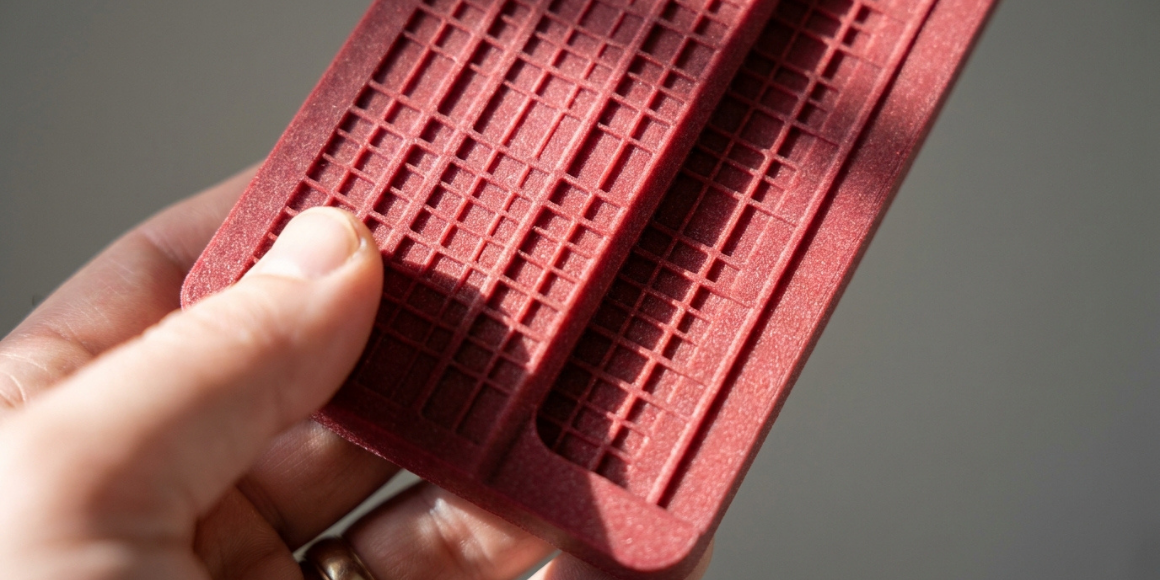
For most of additive manufacturing's history, textured surfaces meant one thing to engineers: a compromise. Visible layer lines signaled an unfinished prototype - something to sand, prime, and paint away before a part could be called production-ready. That assumption is now being overturned. Industrial designers, footwear brands, and consumer electronics makers increasingly treat 3D printing surface texture the way they treat color, material, or form: as a deliberate design variable that shapes how a product looks, feels, and communicates to the person holding it.
In Short
- Visible 3D-printing texture is no longer treated purely as a flaw to mask - it's becoming a design parameter on par with color or material.
- Companies like Slant3D, Materialise, and New Balance (TripleCell) deliberately showcase print structure as a product feature, not a process byproduct.
- Texture affects grip, traction, and tactile feel - not just looks - as confirmed by UX research and commercial case studies.
- A smooth finish is still required wherever sealing, IP rating, optics, or FDA compliance are at stake.
A note on sources: claims in this article draw on two different evidence types. Peer-reviewed studies (Paksoy, 2016; Karjalainen, 2007; Cui, Chattaraman & Sun, 2022; Marciniak, Moon & Bianchi, 2024) provide controlled or theoretically grounded evidence about user perception and brand signaling. Industry sources (Slant3D, Materialise, Protolabs, Makerly, Sinterit) describe commercial practice and are valuable for showing what companies are actually doing, but they are not independently verified research and should be read as practitioner testimony rather than empirical proof.
Why Layer Lines Used to Mean "Unfinished"
The default vocabulary of the 3D printing industry still frames texture as a problem to solve. Surface-finish guides for FDM, SLS, and SLA processes routinely describe visible layer-by-layer ridges and striations as a limitation to minimize through finer layer heights, media blasting, vapor smoothing, or paint. Commercial finishing standards borrow directly from injection molding, applying VDI 3400 spark-erosion grades or Mold-Tech textures to printed parts specifically to disguise the fact that they were printed at all.
Texture as a Deliberate Design Decision
A parallel line of practice is developing that inverts this logic entirely. As the industry outlet Fabbaloo reports, the US production company Slant3D, which runs FDM at industrial scale, argues that most of the smooth surfaces we're used to come from injection molding, casting, or stamping processes where smoothness is a technological necessity, not an aesthetic choice: "molds are smooth because they have to be smooth." Slant3D goes further: "smooth parts are the result of engineering constraints, not deliberate design. We prefer smooth parts because we've always had smooth parts - not because we chose a smooth finish."
The company demonstrates its own texturing methods directly in an instructional video, where the presenter states, at roughly the 1:39 mark, that "there's about three core ways that you can get it done." The video ranks these three techniques explicitly, word-for-word, as "the best option," "the second best option," and "the third best option":
- CAD-based patterning (best option) - modeling a small texture patch directly in CAD software, then replicating and mapping it across the entire part. The most computationally demanding option, particularly on curved surfaces.
- Height-map import in IdeaMaker (second-best option) - importing a grayscale (black-and-white) image as a height map that's imprinted across the part's surface at the slicer stage. Lower computational cost than CAD, but less controllable since it happens outside the CAD file.
- Cura's fuzzy skin feature (third-best option) - adding random surface noise by making the extruder nozzle wobble slightly as it prints. The least controlled option, but the simplest to apply.
.png)
Macro detail of our 3D-printed test block showing a repeatable waffle texture pattern applied via CAD-based patterning.
Two further techniques appear elsewhere in the broader texturing toolkit but are not part of this specific video: a hybrid CAD approach that imports height maps and generates a mesh from them (available, for example, through SolidWorks' 3D texture/mesh-modeling functions), and slicer-level tools like the "SVG modifier" feature in Orca Slicer or PrusaSlicer, which projects a vector map onto a part's surface, or BumpMesh, a free online editor that maps height data onto selected faces of a model. Together, these five techniques - three demonstrated directly by Slant3D, two documented in adjacent tooling - let a designer apply virtually any texture to a part without physically modifying production tooling, a flexibility injection molding can't match, since it requires cutting a new mold for every pattern change. As Fabbaloo's author Kerry Stevenson sums it up in his own commentary on the trend: "layer lines are a feature worth exploiting, not an unwanted side effect."
As Protolabs notes in its analysis of structural surface textures, controlling the finish gives designers a real tool for building brand identity and ergonomics - from a customer's first impression to a confident, comfortable grip - not just a way to disguise the printing process. Materialise, one of the leading players in the 3D printing market, describes 3D texturing as a tool that lets designers add both functional detail (e.g., improved grip) and purely aesthetic, organic patterns faster and more sustainably than traditional methods - without increasing production cost.
Researchers Marciniak, Moon, and Bianchi describe "Texture-Slicer" in a 2024 peer-reviewed paper in Archives of Design Research (vol. 37, no. 1) - a tool that decouples geometry from surface finish by injecting tunable roughness patterns (wavelength, amplitude, vertical spacing) directly at the G-code modification stage during slicing, so a single 3D model can carry multiple interchangeable textures without touching the original CAD file. In a preliminary perception study with six participants, the authors showed that greater pattern amplitude and wavelength increase subjectively perceived roughness - confirming that the tactile effect of texture is measurable and controllable, though the study sample was small.
Manufacturers active in the Polish market, such as Makerly, likewise point out that color and texture in MJF technology are no longer just an aesthetic question but "a powerful tool for building brand identity, designing UX, and increasing product value."
Touch: The Product's Second Communication Channel
The strongest argument for treating texture as design language is that it changes how a user physically interacts with a product - not just how the product looks in a render. İsmail Yavuz Paksoy's master's thesis, defended in 2016 at Middle East Technical University (METU) under the supervision of Dr. Naz Börekçi, analyzed the perception of three-dimensional surface textures on consumer electronics products using the Repertory Grid technique. It found that textures are used for both functional reasons (better grip, marking a contact zone) and hedonic ones - for visual and tactile pleasure.
Similarly, Makerly notes that a matte, rough surface can provide better grip and resistance to visible dirt - relevant for sports equipment, medical prosthetics, handles, and device housings - while a smooth or glossy finish tends to be associated with the premium segment. Choosing a texture is therefore both an aesthetic and an ergonomic decision, with a direct effect on user experience.
This observation is borne out in commercial projects. New Balance's TripleCell platform, developed with Formlabs on the basis of SLA lattice structures and a dedicated Rebound Resin, introduced a visibly 3D-printed lattice heel into the 990 Sport model. It launched in 2019 as a limited run of just 500 pairs, not a mass-market product - the significance of this example lies not in sales volume but in the fact that New Balance chose to market the printed lattice as a visible, headline feature of the shoe rather than hide it inside a conventional-looking sole. The brand bet that consumers would read "visibly printed" as a premium signal, not a defect.
Tianyu Cui, Veena Chattaraman, and Lushan Sun, in a study published in the Journal of Fashion Marketing and Management (2022, vol. 26, no. 2), applied the functional, expressive, and aesthetic (FEA) consumer needs model - originally developed by Lamb and Kallal (1992) in the Clothing and Textiles Research Journal - to a hoodie with 3D-printed TPU inserts. They found that the expressive and aesthetic dimensions of the visible printed elements had a greater effect on satisfaction and purchase intent than functional fit alone: consumers read the printed look as evidence of intent, not an oversight.
Printed Enclosures: Where the Prototype-Product Line Blurs
Case studies documented by fabrication shops show how close the finish quality of printed enclosures has come to production standard - with the caveat that all three examples below are formally prototypes, not parts shipped to an end customer, and one of them actually represents the opposite of this article's thesis:
- A decibel meter (Additive Inn) - the housing was sanded and smoothed to a clean white finish after printing so it would "look like a real product, not a raw print." The maker describes it as a prototype built for a grant application.
- Marine electronics for Ashtree Marine (White Horse CAD) - described by the maker, at time of publication, as a "first production prototype," still awaiting IP-compliance testing.
- C-COR Broadband (Select 3D white paper, case study) - described as a "two-part prototype shell that could potentially move into mass production in the future."
None of these examples, then, directly confirms the shipment of a final part with its printed texture deliberately preserved on display - the stronger, fully verified evidence for that thesis remains the TripleCell platform described above. A stronger supporting case would be documented end-use parts from HP Multi Jet Fusion, where MJF's rough native texture is sometimes accepted as a production finish - worth tracking down before publication.
Setting those case-study caveats aside, the broader market shift toward final-part 3D production is real, even though estimates vary widely by research methodology. VoxelMatters puts the global additive manufacturing market at roughly $12.3 billion in 2024 (split across hardware, materials, and services), forecasting growth to more than $108 billion by 2034 at a 24.4% CAGR. Other analyst firms report substantially higher figures for the same year - TechSci Research, for instance, values the market at $77.10 billion in 2024, while other reports place it anywhere from roughly $21 billion to over $90 billion. The spread comes down almost entirely to methodology: whether a report counts hardware sales alone, or the full ecosystem of materials, software, and related services. Regardless of methodology, every forecast agrees on direction: growth is increasingly driven by end-use part production, not prototyping.
Sinterit, a Polish SLS printer manufacturer, confirms this broader market dynamic using the automotive industry as an example, where additive manufacturing enables faster design and production of lightweight, custom parts - including components visible on the finished vehicle - though this source addresses the prototype-to-production shift generally rather than surface texture specifically. As more parts move from prototype to product, the question of what a printed surface should look and feel like stops being something settled at the finishing stage - it becomes a specification decision made back at the CAD stage, as in our own Neuroplay project, discussed below.
Where Smooth Still Wins
None of this means smoothing has lost its purpose, though. Enclosures that require gasket seals, a specific IP water-resistance rating, optical windows, or FDA-compliant hygienic surfaces still need the layer lines removed entirely. Not because texture can't be controlled - it can, with the same precision described above - but because sealing and optical clarity require an unbroken, continuous contact surface, and any deliberate relief pattern works against that requirement by definition.
The shift described in this article is about expanding the menu of legitimate finish options, not replacing smoothing with texture altogether. A medical device housing and a running-shoe heel have completely different tolerance requirements, and treating texture as a specification decision means choosing the right finish for a given part's function - sometimes the answer is still "as smooth as possible."
Texture as a Brand Signal
Within that expanded menu of legitimate finishes, texture also does something smoothness structurally cannot: it can carry brand identity on its own surface, the way a logo or color palette does. Toni-Matti Karjalainen, in his analysis of visual brand recognition published in the International Journal of Design (2007), shows that companies deliberately choose shape, material, and surface characteristics - repeated consistently as "explicit design cues" - to build a recognizable, value-adding brand identity.
.png)
A distinctive, deliberately engineered print texture can function the same way a signature knurl pattern or a specific paint finish does on a conventionally manufactured product: a signal of process authenticity rather than an unfinished edge.
For design studios working across multiple hardware categories - medical devices, consumer electronics, outdoor and industrial equipment - this opens up a design space that barely existed five years ago: a manufacturing process whose natural surface signature can be turned into a full-fledged finish option, sitting alongside anodizing, powder coating, and injection-molded textures, rather than being treated as their inferior substitute. The visible print becomes the message, not an apology for it.
Designing texture deliberately - as a tool for branding, ergonomics, and technical specification - takes more than a conceptual decision, though. It takes concrete methods: controlling slicer parameters, choosing layer height, mapping patterns onto geometry. That's what Part II of this series covers.
FAQ: Surface Texture in 3D Printing
Are visible layer lines always a problem in 3D printed parts?
No. Layer lines are an inherent feature of the additive process, and current design practice increasingly treats them as a controllable texture parameter rather than an automatic defect - especially on parts that don't need to be sealed or have optical-grade surfaces.
Can 3D printed parts be used as final device enclosures?
Yes, though documented examples with a deliberately preserved, showcased printed texture are still fewer than examples where the texture is removed. The market trend is clearly moving toward 3D-printed final parts, but in the electronics-enclosure segment, the line between prototype and finished product often remains formal, and finishes are still frequently smoothed to "look like a real product." The stronger, fully verified example of exposed texture as a final-product feature remains New Balance's TripleCell platform. From our own experience, we can point to a medical-sector project - Neuroplay - where we built the housing from a combination of sintered polyamide in flexible and rigid variants, chosen primarily for material compliance and biocompatibility rather than for a deliberately exposed-texture aesthetic; production of the housings was ultimately carried out in partnership with Materialise.
How is surface texture added intentionally to a 3D printed design?
Broadly speaking, designers work with displacement or height maps at the CAD stage, or influence roughness parameters at the slicer level. The specific methods, step order, and process constraints of this technique are covered in detail in Part II of this series.
Coming Up in Part II
This article made the design case: texture is a legitimate aesthetic and UX tool, not a limitation to be masked. Part II, "Advanced Surface Texturing as a Layer-Masking Technique" goes into the engineering details - covering the slicing, G-code, and process-engineering methods that make precise, repeatable, production-grade texturing possible. Read Part II.



Schedule an initial talk and get to know us better! You already have a basic brief? Send it over so we can have a more productive first meeting!
a meeting
