
The first prototype lands on the table, and everyone leans in. It looks stunning, but when someone presses the button, nothing happens. Or it works flawlessly and looks like a science-fair project held together with tape.
Most hardware teams hit this fork early. This guide covers the main prototype types (proof of concept, looks-like and works-like), the engineering, design and production validation builds (EVT, DVT and PVT) that follow, and the golden sample that sets the standard for mass production.
In short:
- Proof of concept: Can the idea work at all?
- Looks-like prototype: Does it look and feel right?
- Works-like prototype: Does it actually work?
- EVT: Does the engineered design work as a whole? DVT: Does it meet the spec? PVT: Can the factory build it at scale?
- Golden sample: The approved unit every production unit is checked against.
What Is a Prototype?
A prototype is an early version of a product that you build to answer a specific question before committing to production. Because it only has to answer that question, it's allowed to be unfinished. One object rarely tests form, function and manufacturability at once: a polished looks-like model often has no room for electronics, and a bare functional rig won't win over a buyer. So teams use several types, each with one job, and in our product design process each one is a checkpoint. Our prototype manufacturing services cover builds from proof of concept through to final pre-tooling prototypes (late-stage builds made before you commit to production tooling).
Proof of Concept (PoC): Can the Idea Work?
A proof of concept is a rough, usually physical test of one core principle, such as a mechanism, an electronic component or a new way of joining parts. Speed beats polish, so teams use off-the-shelf components, development boards, cardboard, foam, and 3D-printed or laser-cut parts. A PoC matters most when your product depends on something nobody has built before. If the core technology is already proven in a comparable product, you can often skip straight to looks-like and works-like prototypes. If you're using it in a new way, or at a different size, power or cost, a quick PoC is still cheap insurance.
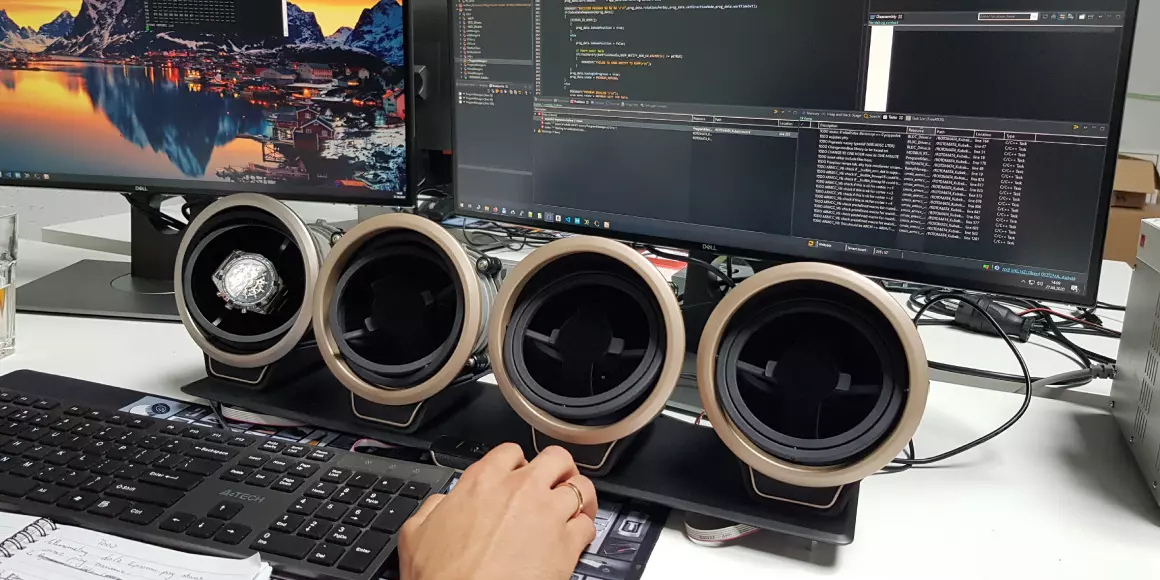
Example: the POTZ Balance watch winder from our portfolio. A watch winder keeps an automatic watch wound while it's not on your wrist, and the category is well established. The gyroscopic motion that reflects the natural movement of a wrist is also well known among high-end watch winders, but in this project we added a rotating motion that lets the watch be wound in an almost vertical position. That solution was new, and we didn't know whether it would work. So we built that mechanism first, with no thought for style or for how to cover it. Only once it worked did we go back to the concept phase and design a premium case worthy of a high-end product. Then, in the mechanical design phase, we turned the proof of concept into a real product with working mechanisms, using parts from different manufacturers that fit the space we had designed. Hear the full story in IDology #2: Prototyping in product development.

Looks-Like Prototype: Does It Look and Feel Right?
A looks-like prototype, also called an appearance model, shows how the finished product will look and feel: size, shape, proportions, color and finish. It doesn't have to work. Buttons can be dummies, and a sticker can stand in for a screen.
Build one when people need to see and hold the product: investor pitches, customer feedback on size and ergonomics, product photography, and color, material and finish (CMF) decisions. Early versions can be foam, clay or cardboard, built in hours. Later ones are sanded, primed and painted 3D-printed or computer-controlled (CNC) machined parts, and that finish is where the cost goes.
Crowdfunding? A looks-like model alone won't get a hardware project onto Kickstarter. Kickstarter's hardware rules require working prototypes and don't allow photorealistic renderings. Show the looks-like model alongside a working prototype.
The pitfall. A beautiful shell can hide engineering problems. If nobody checked that the battery, circuit board and antenna fit inside, you've only proven the outside. That's why our designers confirm with the electronics team that everything fits before the shape is locked.
Works-Like Prototype: Does It Actually Work?
A works-like (functional) prototype proves behavior: the mechanisms, electronics and firmware. Early builds combine development boards, sensors and off-the-shelf parts with quick 3D-printed or machined ones. They look rough, and that's fine.
As the design matures, teams move to custom circuit boards and robust CNC-machined or high-resolution 3D-printed parts, and some use low-volume aluminum or 3D-printed molds (soft or bridge tooling: lower-cost molds built for limited quantities or to cover the gap until production tooling is ready). The prototype starts to match the final product, but the design is still changing and the parts are made with prototyping processes, so it can't prove the product is ready for mass production. That's the job of the EVT, DVT and PVT builds.
Safety note: Keep open builds with exposed wiring on the bench. Before a unit goes to test users, investors or a trade fair, enclose live parts and have its electrical safety reviewed, especially for mains power or lithium batteries. EU rules add conditions for showing electronics that don't yet comply. Under the Radio Equipment Directive (Article 9(2)), non-compliant radio equipment can be displayed at a trade fair only with a visible sign saying it can't be sold or put into service until it complies. It can be demonstrated only if adequate measures, as prescribed by each member state, prevent harmful interference, electromagnetic disturbances and risks to health, safety or property. The EMC Directive (Article 5(3)) has a similar exception for other electronics, limited to electromagnetic disturbances.
Looks-Like vs Works-Like Prototype: What's the Difference?

Building both in parallel often saves time, provided both teams work from the same internal layout so the shell and internals fit.
EVT, DVT and PVT: From Prototype to Production
Eventually the looks-like and works-like tracks become one product, through three validation builds before mass production. Teams merge the two at different points: some integrate looks-like and works-like at EVT, others bring in final cosmetics only at DVT.

Unit counts are indicative ranges from OpusFab (consumer and industrial products) and Venture Electronics (PCB builds). Yours will depend on the product and budget.
Agree on names early. Some companies add a pilot stage between DVT and PVT, and others call EVT a "functional prototype," so confirm the terms with your manufacturer. A pre-production sample (PPS) isn't a separate stage. It's a sample the factory makes on production tooling and materials for your approval. Depending on the factory, it comes from the last DVT build (if that build used final tooling) or from the first PVT run. The golden sample section below explains how it becomes the reference for mass production.
Optional: a final pre-tooling prototype. Some teams add one late-stage build at the end of EVT, made by vacuum casting or precision CNC machining, to catch last-minute issues before tooling is committed. It looks and performs like the final product, but it isn't made on production tooling, and that's what separates it from a golden sample.
Plan certification before DVT. If your product needs CE marking (EU) or Federal Communications Commission (FCC) authorization (US), test samples are often DVT units, though some teams certify on PVT units (Hubble). OpusFab estimates 6 to 12 weeks for FCC, CE or UL (Underwriters Laboratories) testing, so book a lab early. Run first-pass RF checks on EVT units, and run pre-compliance EMC scans on DVT units before formal testing. If the product has a radio, add RF pre-scans with the production antenna in the production enclosure. A formal failure can mean a board respin and a repeat test.
Bring the factory in early. Design for manufacturing (DFM) starts well before EVT, but a formal DFM review before tool release pays off most. Your manufacturer can flag uneven wall thickness, sharp internal corners, missing draft angles and over-tight tolerances while they're still cheap to fix.
How Much Do Prototypes and Tooling Cost?
Prototype costs climb with fidelity (all prices in US dollars). A simple 3D-printed enclosure can cost $10 to $50 if you order the print yourself. On one of our projects in 2022, a hand-finished, painted prototype with working rubber buttons cost about $2,000, mostly for finishing labor. Treat these as examples, not quotes.
Tooling varies far more. Formlabs, a 3D printer maker, puts plastic injection molds at anywhere from about $100 for a simple 3D-printed low-volume mold to $100,000 or more for a complex multi-cavity steel mold, and about 2,000–5,000 for aluminum molds covering roughly 1,000–5,000 units. Printed molds typically make hundreds of parts, and fewer in engineering plastics. Get quotes for your own part.
Once a mold is cut, removing metal is easy but adding it back is hard. Making a wall thinner or a hole larger means adding metal to the tool, and with rapid-tooling molds that can mean remaking the mold (Protolabs). Even a small change adds cost and lead time.
That's why the prototypes worth building before tooling are usually functional and fit-check builds, which cost far less than a painted model. Against a low-cost aluminum mold, an extra round may not pay off; against complex steel tooling, it's cheap insurance. The right question isn't prototype or tooling. It's how much risk each extra round removes before you commit to the tool.

What Is a Golden Sample in Manufacturing?
A prototype exists to teach you something. A golden sample exists to settle what "right" looks like. It's the reference unit your factory makes on production tooling, with production components and materials, and that you formally sign off before mass production. Some factories also call it an approval sample or master sample. It captures the agreed materials, color, finish, function and packaging, usually in several identical signed copies.
You'll sometimes hear "golden sample" used loosely for the final pre-tooling prototype. In manufacturing and quality control, though, it means the factory-made reference unit described here, and that's the sense we use in this guide.
When is it approved? A golden sample is normally a signed copy of the approved pre-production sample (PPS). Some sources place that at the end of DVT (Sofeast), others at PVT or the pilot run (Audecy). What matters is the build, not the stage name: the unit must come off the final production tooling, with the materials that will run in volume. DVT units on soft or bridge tooling don't qualify. Agree the approval point with your manufacturer, in writing.
Why it matters. Without a golden sample, "good quality" is a matter of opinion. If a batch arrives with a different finish or a looser fit, both sides can point to a reference they've signed, and inspectors use it during inline and pre-shipment checks. After approval, we compare the first production units against it and agree fixes with the factory.
Golden Sample vs Pre-Production Sample vs Prototype
A PPS is the factory's proof that it can make your design on the real line. You approve it or send it back; two rounds is common for a new product (Importivity). Approved PPS copies become your golden samples. A PPS isn't a PVT run: it's a small sample for your approval, while PVT tests whether the line can repeat that result at volume. A prototype sits on a different branch: it proves the design works, not that the factory can build it.

A golden sample works alongside a written spec, a signed BOM and a QC checklist; it doesn't replace them.
How to Approve a Golden Sample in 5 Steps
- Freeze the design and write the spec. Document materials, dimensions, tolerances, color (a Pantone or RAL reference, or a measured value with an allowed variation), finish, labeling and packaging.
- Review pre-production samples. Test function and finish against the spec, then approve or send back with specific written feedback.
- Sign, date and seal it. Both sides sign and reference the spec revision, so nobody can quietly swap the sample.
- Make copies and store them properly. Keep at least one each for you, the factory and your inspection company, sealed, labeled and away from light, heat and humidity.
- Update it when things change. Approve a new sample if you change a material, component or supplier. Sofeast suggests refreshing color-critical samples every 6 to 12 months.
Two mistakes to avoid: approving before the design and tooling are stable, and keeping a single copy. Where finish matters, also approve limit samples showing the worst acceptable variation, so inspectors can judge borderline units against a physical reference.
Is a Golden Sample Legally Binding?
A golden sample isn't a contract, but it can become part of one. Under the UN Sales Convention (CISG), goods must have the qualities of a sample the seller held out to the buyer, unless the parties agreed otherwise (Article 35(2)(c)). The CISG covers many cross-border business sales, but not every country is a party (the UK, India and Taiwan, for example, are not; check UNCITRAL's status list), and parties can exclude it in their contract (Article 6). In the US, the Uniform Commercial Code treats a sample that's part of the basis of the bargain as an express warranty that the goods will conform to it (UCC § 2-313). Name the golden sample in your supply agreement, tie it to the spec and revision, and have a lawyer review the wording. This isn't legal advice.
Which Prototype Do You Need Right Now?
- Can the idea work at all? A proof of concept.
- Will investors or customers like the look and feel? A looks-like prototype, plus a works-like prototype or demo if they need to see it work.
- Does the mechanism, sensor or circuit work? A works-like prototype.
- Is the design ready for tooling? EVT builds, plus a final pre-tooling prototype if you need one.
- Does it meet the spec on production-intent parts? DVT.
- Can the factory build it reliably at scale? PVT.
- How do you keep every production unit consistent with what you approved? A golden sample, used with a written spec and a QC checklist.
FAQ
What do EVT, DVT and PVT stand for?
Engineering, Design and Production Validation Test. EVT checks whether the engineered design works, DVT checks whether it meets the spec, and PVT checks whether the factory can build it reliably at scale.
What's the difference between a golden sample and a pre-production sample?
A pre-production sample is what the factory submits to prove it can build your design on production tooling. Once you approve it, signed copies become the golden samples every later unit is checked against.
How many golden samples do I need?
At least three: one for you, one for the factory and one for your inspection company.
Still deciding what to build next? Book a prototyping consultation and we'll help you choose the right step!



Schedule an initial talk and get to know us better! You already have a basic brief? Send it over so we can have a more productive first meeting!
a meeting
